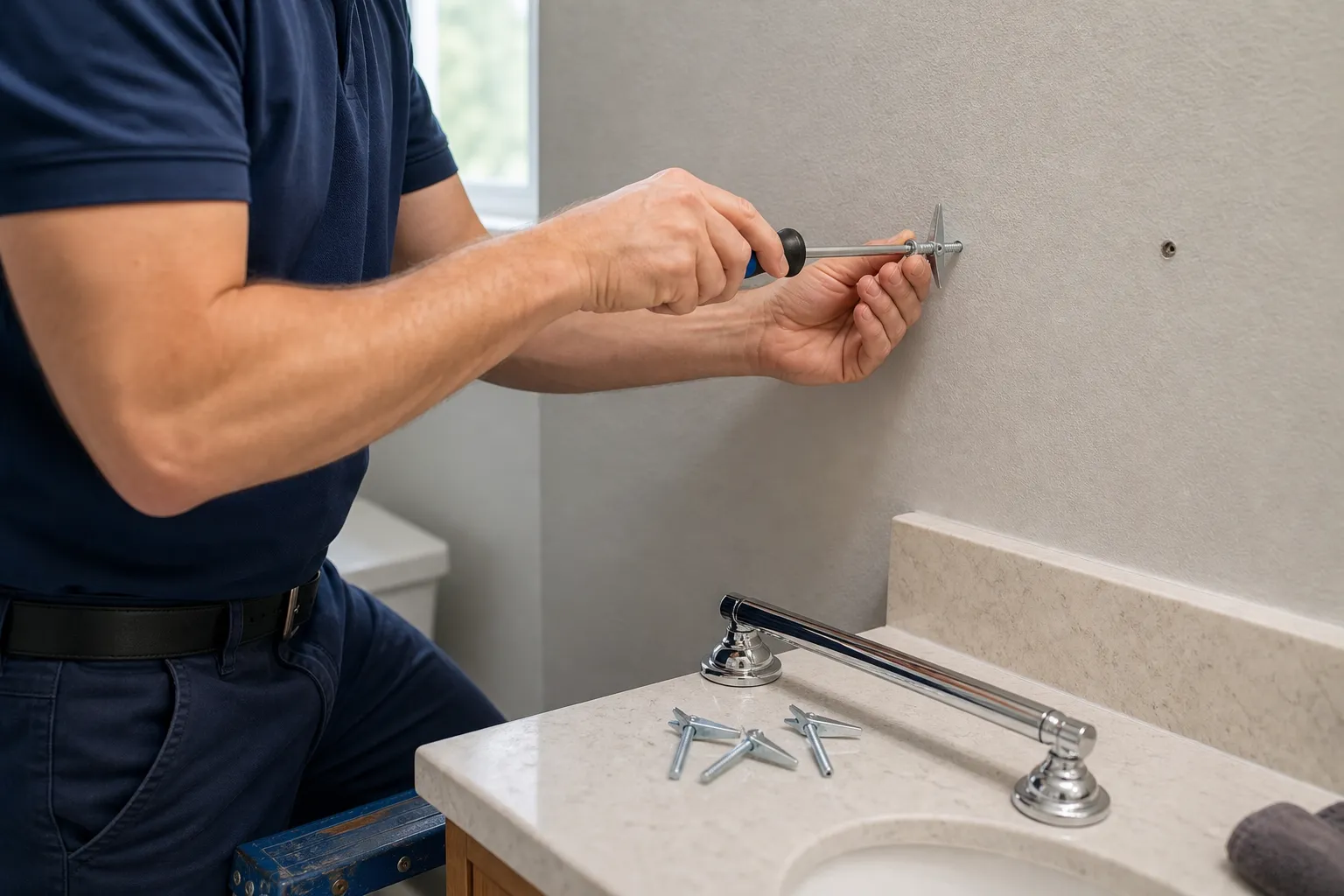
A towel bar that wobbles, sags, or pulls clean out of the wall the first time someone grabs it for balance is almost never the bar's fault - it's the anchor behind it. Whoever mounted it drove a screw into hollow drywall with a flimsy plastic anchor that was never rated to hold the yank of a wet towel and an occasional hand, and the drywall finally gave up.
The good news: remounting a towel bar so it actually holds is a 30-minute job with the right anchor and a screwdriver. When it's better to call a pro: if the wall is tile and you're nervous about drilling into it, if the existing holes have blown out into a crater of crumbled drywall, or if the bar keeps failing no matter what you try, it's worth having it done right - a cracked tile or a torn-up wall costs far more than the bar.
Why Towel Bar Anchors Fail
A towel bar looks like it just holds a towel, but people lean on them, kids hang off them, and a soaked towel adds real weight and leverage. The mounting point takes a sharp pulling-out (pullout) load, which is exactly what cheap expansion anchors are worst at. When a bar comes loose, one of three things has happened: the plastic anchor stripped out of the drywall, the screws were driven straight into drywall with no anchor at all, or the mount was into hollow wall right next to a stud that a longer screw could have caught. Fixing it for good means matching the anchor to the wall and the load - not just cranking the old screw tighter, which only chews the hole bigger.
Tools & Materials You'll Need
- Screwdriver and/or a drill with bits
- A stud finder
- Heavy-duty anchors rated for the load - metal toggle bolts or self-drilling toggle (molly) anchors for drywall
- For tile: a carbide or masonry drill bit and plastic sleeve anchors
- Painter's tape
- Lightweight spackle or a drywall patch kit for the old holes
- Putty knife and a bit of sandpaper
- A level
How to Remount a Towel Bar So It Holds
Remove the bar and mounting posts
Most towel bars have a small setscrew underneath each end post - loosen it with a hex key or small screwdriver and the bar and posts lift off the wall-mounted brackets. Unscrew the brackets and pull any old anchors out of the wall so you can see what you're working with.
Look for a stud first
Run a stud finder across the mounting area. If a bracket lands on or near a stud, mounting a screw straight into solid wood is by far the strongest option - no anchor beats a stud. Often only one end hits a stud; that's fine, anchor the other end properly.
Choose the right anchor for hollow drywall
Where there's no stud, skip the small plastic cone anchors - they're what failed in the first place. Use a metal toggle bolt or a self-drilling toggle (molly) anchor rated for a solid pullout load. These spread their grip across the back of the drywall instead of just wedging into a crumbly hole, so they hold a hard yank without tearing out.
If the wall is tile, drill without cracking it
Mounting into tile takes care but isn't hard. Mark your spot and put a small X of painter's tape over it to keep the bit from wandering. Use a carbide or masonry bit and start the drill on low speed with light pressure and no hammer setting - let the bit grind through the glaze slowly. Once you're through the tile, insert a plastic sleeve anchor. Drill into the tile face, not the grout line, since the solid tile body holds an anchor better than a crumbly seam.
Mount the brackets level and reattach
Set the brackets, check them with a level so the bar hangs straight, and drive the screws firmly into the anchors or stud. Slide the posts and bar back on and re-tighten the setscrews underneath. Give the bar a real tug to confirm it's solid before you trust it with a towel.
Patch the old holes
If the new position doesn't cover the old holes, fill them with lightweight spackle, let it dry, sand it flush, and touch up with paint. For a blown-out hole bigger than a dime, use a small self-adhesive mesh patch under the spackle so it has something to bridge.
Common Mistakes to Avoid
- Reusing the same cheap plastic anchors. They're why the bar fell off. Step up to toggle or molly anchors, or hit a stud.
- Driving screws into bare drywall with no anchor. Drywall has almost no grip on its own - the screw will pull straight back out.
- Drilling into a tile on hammer mode or high speed. That's how tiles crack. Slow speed, light pressure, carbide bit, tape over the spot.
- Anchoring into the grout line instead of the tile. Grout is softer and crumbly; the solid tile body holds far better.
- Overtightening. Cranking the screws too hard can strip the anchor or crack the tile - snug and level is the goal.
When to Call a Handyman
Call a pro if the wall is tile and you'd rather not risk drilling into it, the old holes have crumbled into a crater the size of a coin or larger, or the bar keeps working loose no matter what anchor you try - that usually means the drywall itself is damaged and needs backing or a patch first. Our caulking and grout service in Santa Clarita handles bathroom fixture mounting and tile work, so a loose towel bar, a wobbly toilet-paper holder, and a cracked grout line can all be sorted in a single visit.
Estimated time: About 30 minutes for a straightforward drywall remount; add 15–20 minutes if you're drilling into tile or patching old holes.