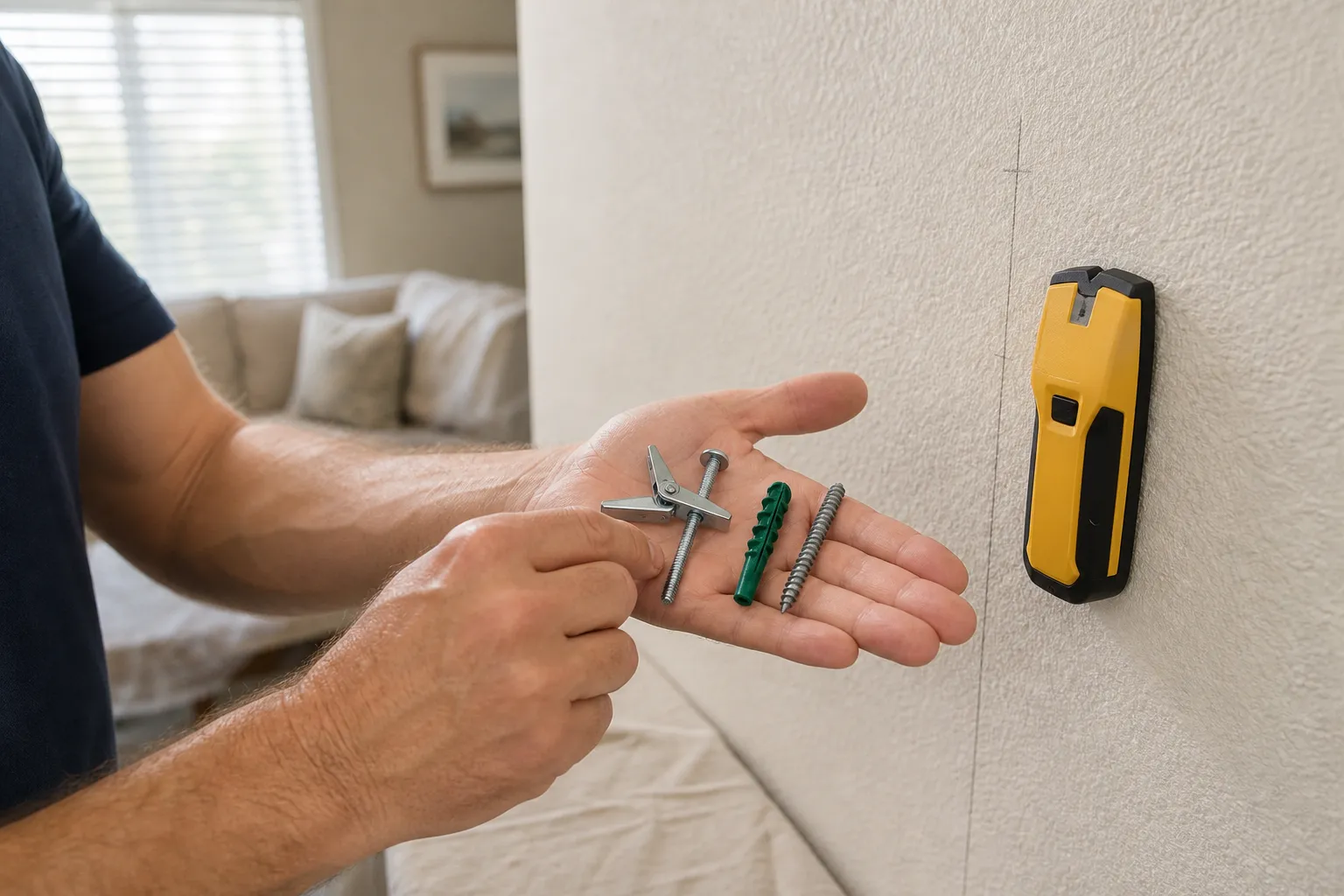
Almost everything that falls off a wall falls for the same reason: someone trusted a drywall anchor to do a stud's job. Drywall is only about half an inch of compressed gypsum with a paper face - strong enough to hold a picture frame, nowhere near strong enough to hold a loaded floating shelf or a swinging TV mount on its own. The good news is that knowing which fastener to use is mostly a matter of matching the weight and the leverage to the right hardware.
The short version: light, static loads can ride on the right anchor; heavy loads and anything with leverage - TVs, big shelves, grab bars, cabinets - belong on a stud. Below is how to tell which is which, what each anchor type actually holds, and how to find the studs you need.
Why Heavy Things Pull Out of Drywall
Two forces are at work, and people usually only think about one of them. The first is straight pull-out - the weight hanging directly down and out from the wall. The second, and the real killer, is shear and leverage: a shelf sticking 10 inches out, or a TV arm that swings, multiplies a modest weight into a hard prying force at the top anchors. That's why a 30-pound shelf loaded with books can rip out fasteners rated well above 30 pounds - the leverage at the top edge far exceeds the raw weight. Gypsum crumbles under that prying long before the screw itself gives.
Know the Weight Rating - and Halve It
Every anchor lists a weight rating on the package. Treat those numbers as best-case lab conditions in perfect drywall, not a promise. A sensible rule: use anchors rated for at least double what you're actually hanging, keep the load static (not something you'll tug or swing on), and spread heavy loads across several anchors instead of one. If you find yourself doing that math for anything really heavy, that's usually the wall telling you to find a stud.
The Common Drywall Anchor Types
- Plastic expansion anchors (the ribbed cone that comes bundled with everything): the weakest option. They squeeze against the drywall as you drive the screw. Fine for light, static items - a small frame, a smoke detector, a lightweight towel ring. They pull out easily under any real load or leverage.
- Self-drilling (threaded) anchors, plastic or zinc: they screw straight into drywall without a pilot hole and bite over a wide thread. A solid step up for mid-weight items like a coat hook, a small mirror, or a curtain bracket. Metal ones hold more than plastic. Still not for heavy or leveraged loads.
- Molly bolts (sleeve anchors): a metal sleeve that splays open into an umbrella behind the drywall as you tighten it, spreading the load over a bigger area. Good for medium-heavy static items and reusable once set. Stronger than expansion or self-drilling anchors.
- Toggle bolts (spring-wing or strap-style like Snaptoggle): the strongest drywall-only option by a wide margin. A metal bar or spring wings open flat against the back of the drywall and clamp a large area. This is what you use when you genuinely can't hit a stud and the load is heavier - but even the best toggle is still limited by the strength of the gypsum it's pressed against.
When a Stud Is Mandatory
For some jobs, no drywall anchor is the right answer - the fastener has to go into the wood (or metal) framing behind the wall. Mount into a stud, not just an anchor, whenever you're hanging:
- A TV. A mounted TV combines real weight with constant leverage, and a tilting or full-motion arm makes it far worse. TV mounts are engineered to bolt through drywall into at least one or two studs - that's not optional.
- Heavy or deep shelving. Floating shelves and anything that holds books, dishes, or a stack of anything belongs on studs because of the leverage at the bracket.
- Wall cabinets. Kitchen and garage uppers carry serious loaded weight and must hit framing.
- Grab bars and handrails. Anything a person will put body weight on - never trust these to drywall anchors.
- Heavy mirrors and large art. Big, heavy pieces should catch a stud or hang from a proper cleat screwed into studs.
How to Find the Studs
Use a stud finder - and confirm it
Run an electronic stud finder slowly across the wall and mark both edges of each stud; the center is your target. Studs are usually spaced 16 inches on center (sometimes 24), so once you find one, measure over to predict the next.
Verify before you commit
Stud finders get fooled by pipes, wiring, and seams. Confirm with a small test: a thumbtack or a fine drill bit where the mount will hide the hole should hit solid wood, not empty give. Knocking (solid vs hollow) helps too.
Screw into the stud center
Drive a proper wood screw (a lag or structure screw for a TV mount) through the drywall into the middle of the stud. Catch the edge and it can split out or lose most of its grip, so aim for center and pre-drill for heavy fasteners.
No stud where you need one? Adapt.
If the stud isn't where the mount wants it, shift the item over to reach one, use a mount with wider bracket spacing, or add a wood or plywood cleat screwed across two studs and mount to that. For a heavier item, don't just fall back on anchors and hope.
Common Mistakes to Avoid
- Trusting the packet anchors. The little plastic cones bundled with a shelf are the weakest type made. Upgrade them for anything but the lightest item.
- Ignoring leverage. A light shelf that sticks far out prys on its top anchors far harder than its weight suggests. Deep or protruding loads want studs.
- Reading the weight rating as a guarantee. Those numbers assume perfect drywall and a static pull. Give yourself a big safety margin.
- Guessing at the stud. An anchor half-caught on a stud edge is worse than a clean anchor - verify before you drill.
- Anchoring anything you'll put body weight on. Grab bars and handrails go into framing, full stop.
When to Call a Handyman
If you're mounting a TV, hanging heavy cabinets, or the studs simply aren't where you need them, it's worth having it done right the first time - a dropped TV costs far more than the mounting. Our TV mounting service in Santa Clarita locates studs, mounts into solid framing (or builds a proper cleat when the layout doesn't cooperate), and hides the cables - so your TV stays exactly where you put it.
Estimated time: 10–15 minutes to set a few anchors for a light item; 30–60 minutes to find studs and mount something heavy like a TV bracket safely.