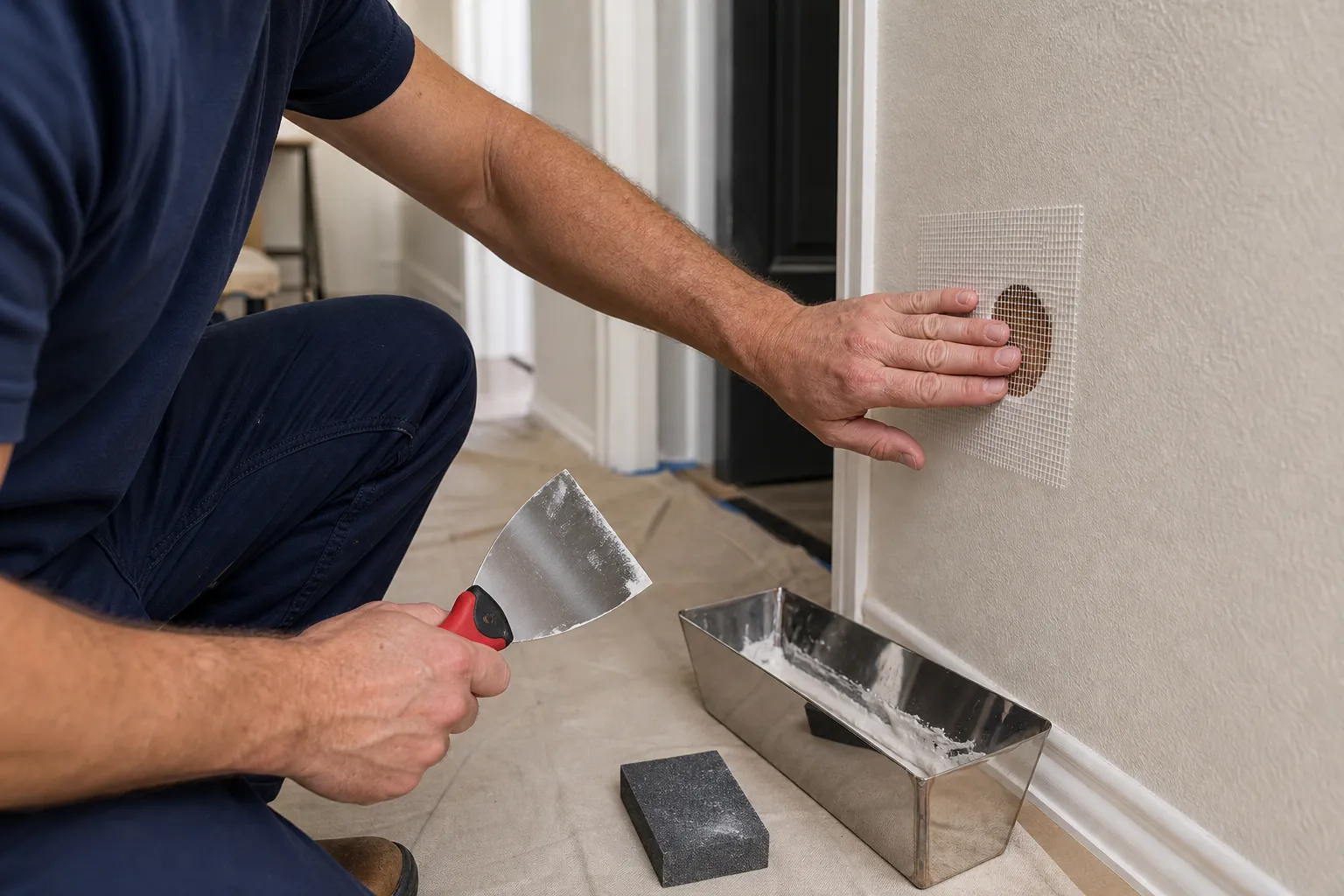
A doorknob that punched through the wall, an anchor that tore out when you moved a shelf, a scatter of nail holes left behind after you rehung the pictures - small drywall damage is the most common repair in any home, and most of it is genuinely a weekend DIY job. The trick isn't the patching itself; it's getting the finished wall flat and textured so the repair disappears instead of announcing itself under the hallway light.
Quick Answer
Fill nail holes and dents with lightweight spackle. Cover holes from about 1/4 inch to 2 inches (a 1-inch hole included) with a self-adhesive mesh patch and two or three thin coats of joint compound. Fix 2- to 6-inch holes with a California patch cut from scrap drywall. Then sand, match the wall texture, prime, and paint.
When it's DIY-friendly: holes up to about the size of your fist, dents, and nail or anchor holes on a flat wall you can reach. When to call a pro: holes bigger than about 6 inches, anything on a ceiling, water-stained drywall, or a heavily textured wall you can't match. We'll cover the DIY method below and flag exactly where the line is.
Match the Patch to the Hole
The right repair depends entirely on the size of the damage. Using the wrong method - spackle over a hole that's too big, or a bulky patch on a pinhole - is what makes DIY drywall look like DIY drywall.
- Nail holes and dents (up to ~1/4 inch): lightweight spackle and a putty knife. No patch needed.
- Small holes (1/4 inch to ~2 inches): self-adhesive fiberglass mesh patch or a paper-faced patch over the hole, then joint compound.
- Medium holes (2 to ~6 inches): a California patch (also called a blowout or butterfly patch) - a cut piece of new drywall with the paper backing left on as flaps.
- Larger than ~6 inches: a backed patch or a full drywall cut-in screwed to the studs. This is where most people should call a pro.
Tools & Materials You'll Need
- Self-adhesive fiberglass mesh tape or a stick-on patch (for small holes)
- A scrap of 1/2-inch drywall (for a California patch)
- Joint compound - lightweight "all-purpose" mud, or fast-setting "hot mud" if you're in a hurry
- A 4-inch and a 6-inch taping knife (a wider knife feathers better)
- Utility knife and a drywall saw or keyhole saw
- 120- and 220-grit sanding sponge, plus a dust mask
- Primer and matching wall paint
- A texture method to match your wall (spray can, sponge, or knife - see below)
How to Patch a Small Drywall Hole, Step by Step
Clean up the hole first
Cut away any loose, crumbling paper or gypsum with a utility knife so you're working with a clean edge. Push any raised, cratered edges (common with a doorknob dent) back flat, or trim them off. Compound will not bond to loose debris - a two-minute cleanup here saves a cracked patch later.
Bridge the hole with the right patch
For a small hole, press a mesh or paper patch flat over it, centered. For a medium hole, cut a square of new drywall an inch larger than the hole, score and snap away the gypsum on the back so a 1-inch "flange" of paper remains on all four sides, then set the drywall plug into the hole and butter compound behind the paper flaps so they stick flat to the wall. That paper flange is what a California patch relies on instead of studs.
Apply joint compound in thin coats
The single biggest DIY mistake is trying to fill everything in one thick pass. Instead, spread a thin first coat over the patch with your 4-inch knife, pressing mud into the mesh so it disappears. Let it dry, then apply a second and usually a third coat, each one slightly wider than the last. Thin coats dry flat; thick coats crack and shrink into a visible dish.
Feather the edges wide
With each coat, switch to the wider 6-inch knife and drag the mud outward so it thins to nothing at the edges. You're not just filling the hole - you're blending the repair into the surrounding wall over an area 8 to 12 inches across. Feathering is what makes a patch vanish; a patch that stops abruptly at the hole always shows.
Sand smooth - lightly
Once fully dry, sand with a 120-grit sponge, then finish with 220-grit. Run your bare hand over the area with the lights low and raking across the wall; your palm finds ridges your eyes miss. Sand only until it's flush - sand too hard and you'll fuzz up the paper and gouge fresh valleys you'll have to re-mud.
Match the texture
Most Santa Clarita walls aren't glass-smooth - they carry a light orange-peel or knockdown texture. Match it before you paint or the smooth patch will glare. A spray-can orange-peel texture, dabbed on and knocked down with a wide knife once it dulls, matches most tract-home walls. Practice on cardboard first to dial in the spray.
Prime, then paint
Always prime the patch first. Bare joint compound soaks up paint differently than the rest of the wall, leaving a dull "flashing" halo even under matching color. A quick coat of primer seals it, then paint the whole wall corner-to-corner if you can - feathering paint into old paint rarely hides as well as priming and repainting a full section.
How to Patch a Nail Hole in Drywall
Nail holes don't need the full process above. Push a dab of lightweight spackle into the hole with a putty knife, then scrape the knife flat across the wall so the spackle sits flush, not in a mound. Once it's dry (usually under an hour for lightweight spackle), give it a light pass with a 220-grit sponge and dab on primer. If you're filling a whole wall of picture-hanging holes, do them all at once and plan on two coats - spackle shrinks a little as it dries, and the second pass levels it out.
How to Patch a 1-Inch Hole
A 1-inch hole - the classic size left by a torn-out anchor or a cable pass-through - is too big for spackle alone. With nothing behind it, spackle sags into the void and cracks. Trim the torn paper edges, stick a 4-inch self-adhesive mesh patch over the hole, and skim joint compound through the mesh with a 4-inch knife. Two or three thin coats, each feathered a little wider, will hide it completely.
Patching a Small Hole Without a Drywall Piece
For anything under about 2 inches, you don't need scrap drywall at all. A stick-on mesh or metal-backed repair patch from any hardware store bridges the opening, and joint compound does the rest. For holes between 2 and 4 inches with no scrap on hand, the metal-reinforced versions of those patches are rigid enough to hold. Beyond that, you need real backing - either a California patch or wood furring strips screwed inside the hole to carry a cut-in piece.
What About Plaster Walls?
Plaster behaves differently from drywall. It's harder, it cracks rather than dents, and it's often keyed to wood lath behind it. For small holes, a setting-type compound ("hot mud") bonds and hardens better than premixed spackle, and a bonding agent brushed on the old plaster first keeps the patch from popping loose. If the plaster around the hole is crumbling or has pulled away from the lath, that's a bigger repair - press on the wall nearby, and if it flexes or crunches, the problem extends past the hole.
What's the Best Patch for Small Holes?
- Nail and screw holes: lightweight spackle - it dries fast and sands easily.
- 1/4 inch to 2 inches: self-adhesive fiberglass mesh patch plus all-purpose joint compound.
- 2 to 4 inches: metal-reinforced stick-on patch, or a California patch if you have scrap drywall.
- 4 to 6 inches: California patch.
- Plaster walls: setting-type compound with a bonding agent.
Common Mistakes to Avoid
- One thick coat of mud. It shrinks, cracks, and sinks into a visible crater. Three thin coats beat one heavy one every time.
- Skipping the patch on a hole that needs one. Spackle bridged across an open hole with nothing behind it will crack and fall through.
- Feathering too narrow. A patch blended over only 3 inches leaves a bump you'll see forever in raking light.
- Painting over bare compound. No primer means a dull flashed spot even with the exact same paint.
- Ignoring the texture. A dead-smooth patch on a textured wall stands out more than the original hole did.
When to Call a Handyman
Patch it yourself if the hole is small, on a flat reachable wall, and the texture is simple. Call a pro when the hole is bigger than your fist, it's on a ceiling, the drywall is soft or stained from water, or you've got a heavy knockdown or textured finish you can't blend. Texture matching in particular is more art than instruction - it's the step DIY patches fail on most. Our drywall repair service in Santa Clarita handles large holes, ceiling patches, water damage, and texture matching so the wall reads as if nothing ever happened.
Estimated time: 30 minutes of hands-on work for a small patch, but spread over 1–2 days because each coat of compound has to dry before the next. Texture and paint add another short session.