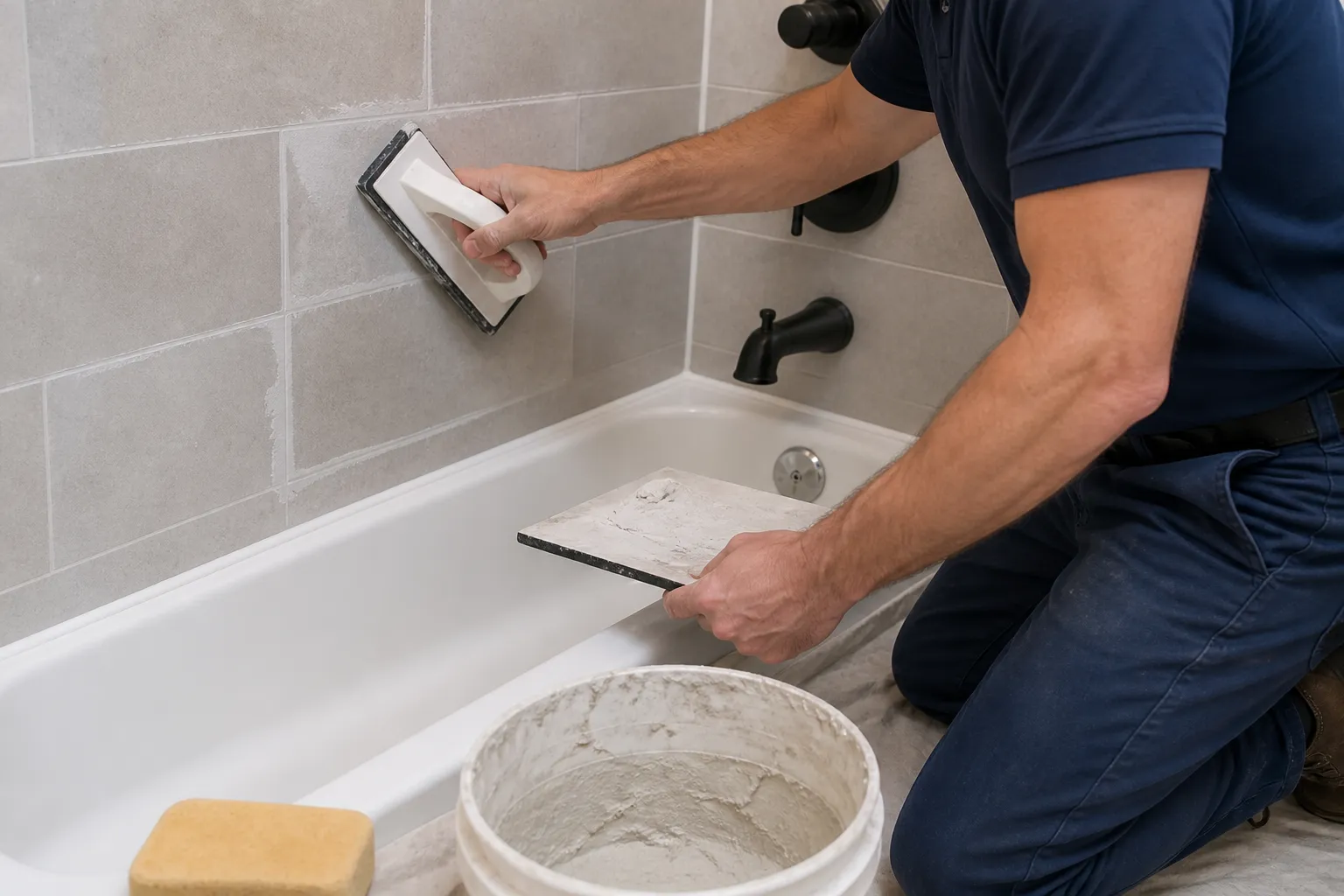
Grout and caulk look like they do the same job - they both fill the lines between tiles and keep a bathroom looking finished. But they are not interchangeable, and putting the wrong one in the wrong place is one of the most common reasons a nice-looking tile job starts to crack, stain, and leak a year or two later. The rule is simpler than most people think: grout goes where nothing moves, caulk goes where things do.
This is a "know before you fill" article rather than a step-by-step. If you're re-doing the seams in a shower or tub and can't tell which product belongs where, a few minutes here will save you from redoing the whole thing. When to call a pro: if grout is crumbling across a whole floor or wall, or a flex joint has been leaking long enough to soften the wall behind it, you're past a simple reseal - skip to the callout below.
The One Rule That Decides It
Every seam in a tiled bathroom is either a joint between two tiles sitting on the same flat plane, or a joint where something changes - a corner, an edge, or where tile meets a different material like a tub, a countertop, or a shower pan. That distinction is the whole answer:
- Grout belongs on tile-to-tile joints on the same plane - the field of a tiled wall or floor where everything is rigid and stays put.
- Caulk belongs on every joint that moves or changes plane - inside corners where two walls meet, where the wall tile meets the tub or shower pan, where a countertop meets a backsplash, and around the edges where tile meets a fixture.
Grout is a rigid, cement-based filler. Once it cures it's essentially a thin strip of mortar - hard, porous, and with almost no give. That's perfect between tiles that never move relative to each other. Caulk (silicone in a wet area) stays flexible for years, so it can stretch and compress as a joint opens and closes without tearing loose.
Why Grout on a Flex Joint Always Fails
Here's the part people learn the hard way. The joint between your wall tile and the tub is not a still joint. When you fill a bathtub with water - or yourself - the weight flexes the tub downward a fraction of an inch, then it springs back when the tub empties. Framing expands and contracts with heat and humidity too. That's tiny movement, but it happens thousands of times.
Grout can't flex. So every time that joint moves, the rigid grout gets stressed until it does the only thing it can: it cracks. Once it cracks, water runs straight through the hairline gap into the wall cavity or under the tub, where it has nowhere to dry. The grout looks fine from the front for a while, but behind it the drywall is going soft. That's why a tub-to-tile line filled with grout will crack and leak, while the same line filled with flexible silicone rides the movement and stays sealed. Change-of-plane and movement joints are caulk joints, full stop.
Quick Reference: What Goes Where
- Tile-to-tile on a wall or floor → grout
- Inside corner where two tiled walls meet → caulk
- Wall tile to the tub or shower pan → caulk
- Backsplash to countertop → caulk
- Around a faucet, drain, or fixture edge → caulk
- Floor tile to the base of the tub or a wall → caulk
A handy tie-breaker: if the two surfaces you're sealing can move independently of each other, use caulk. If they're locked together on the same rigid plane, use grout.
Matching and Blending
People often avoid caulk in the corners because grout looks more uniform. You can have both: caulk manufacturers sell colors matched to common grout shades, and there are sanded caulks made to mimic the texture of a sanded grout line so the flex joint blends in with the grouted field around it. You get the correct flexible product in the moving joint and a seam that still looks like continuous grout.
Common Mistakes to Avoid
- Grouting the inside corners and the tub line. The single most common bathroom-tile mistake - it looks clean on day one and cracks within a season.
- Caulking over cracked grout instead of fixing it. If grout in the flat field is failing, that's a grout or substrate problem; a smear of caulk on top just traps the issue.
- Using acrylic latex caulk in a wet joint. Even in the right location, painter's caulk breaks down underwater. Use 100% silicone in showers and tubs.
- Layering caulk over old grout in a corner. Dig the failed grout out of the corner first, then caulk the clean joint - caulk won't bond well over crumbling cement.
When to Call a Handyman
Call a pro if grout is crumbling across a whole wall or floor, a flex joint has leaked long enough that the wall behind it feels soft, or you're not confident telling a movement joint from a rigid one before you start. Getting the grout-versus-caulk call right the first time is exactly what prevents the slow leaks that rot out a wall. Our caulking and grout service in Santa Clarita regrouts tile, recaulks the movement joints correctly, and reseals showers and tubs so the waterproofing lasts.
Estimated time: Deciding what goes where takes five minutes; recaulking the movement joints in a single shower or tub is a 1–2 hour job, and a full regrout of a wall or floor is a longer half-day project.