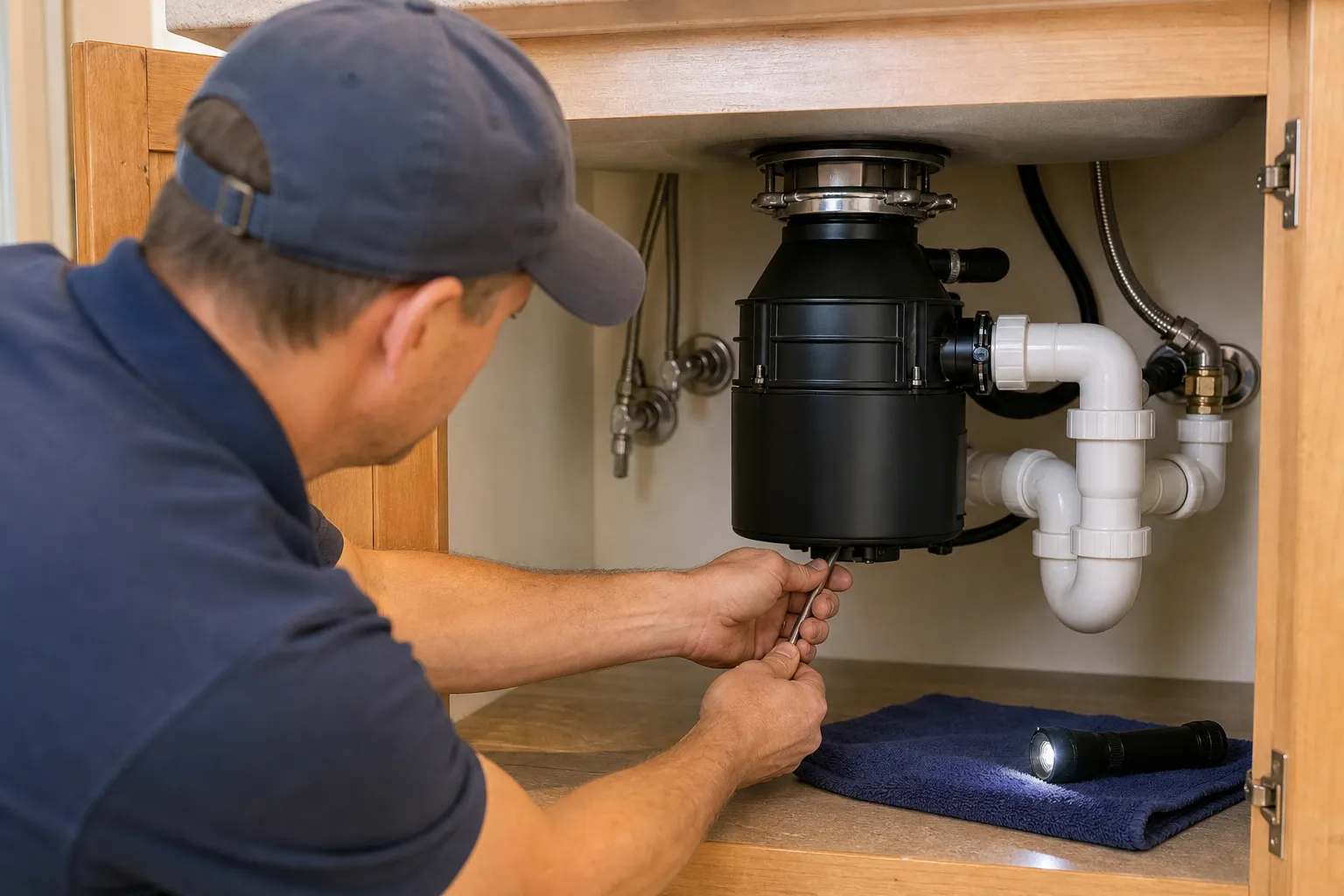
You flip the switch and the disposal hums - but nothing grinds. That low, angry buzz with no spinning is one of the most common kitchen calls we get, and it almost always means the same thing: something is wedged against the shredder plate and the motor can't turn it. A fruit pit, a bit of bone, a stray fork, or a wad of fibrous celery is enough to lock it up. The motor is fine; it's just stalled.
The good news: a jammed disposal is one of the most DIY-friendly repairs in the house, and you can usually clear it in five minutes with a single hex wrench. When to call a pro: if the unit is silent (no hum at all), leaking from the bottom, or won't restart after you've freed the jam and hit the reset button, the motor or seals have likely failed - that's a replacement, not a repair. Below is exactly how to tell the difference safely.
First, Understand What the Humming Means
A garbage disposal that hums but won't spin is drawing power but can't rotate. Leave it humming and the motor will overheat in seconds, then trip its internal breaker (the reset button) to protect itself. So the very first move is not to keep flipping the switch - it's to shut everything off. Every step below starts from a disposal that is completely powered down. There is a spinning shredder plate inside that housing, and it will move again the moment power returns.
Safety First - Kill the Power
This is the step people skip, and it's the one that sends people to the ER. Before your hand or any tool goes near the disposal:
- Turn the wall switch OFF. Then leave it off.
- Unplug the unit if you can reach the outlet under the sink, or flip its breaker in the panel. Don't rely on the wall switch alone - a bumped switch is all it takes.
- Never put your hand down the disposal. Not to feel around, not to pull out a jam, not even with the power off. Use tongs, pliers, or a flashlight and your eyes - never fingers.
Tools & Materials You'll Need
- The 1/4-inch hex (Allen) wrench that came with the disposal - a jam wrench. Most units ship with one clipped under the sink; a standard 1/4-inch Allen key works if it's lost.
- A flashlight
- Long-nose pliers or kitchen tongs (for retrieving debris)
- A wooden spoon or a broom handle (optional, for turning the plate from the top)
How to Free a Jammed Disposal, Step by Step
Confirm the power is off
Wall switch off, unit unplugged or breaker off. Do not proceed until you've physically cut the power at the outlet or panel - not just the switch.
Look inside with a flashlight
Shine a light down the drain. Often you'll spot the culprit - a bone, a pit, a piece of glass, a spoon - wedged against the grinding ring. If you can see it, fish it out with tongs or long-nose pliers. Never use your hand.
Find the hex slot on the bottom
Reach under the sink and feel the center of the disposal's underside. There's a six-sided socket - the manual-turn slot - molded into the bottom. This connects directly to the motor shaft and lets you rotate the shredder plate by hand.
Work the wrench back and forth
Insert the 1/4-inch hex wrench and turn it firmly - clockwise, then counter-clockwise, rocking it. You're using leverage to break the jam free. Keep working it until the shaft spins a full, easy rotation in both directions. That free spin means the obstruction has cleared.
Remove any freed debris
Whatever was stuck is now loose in the chamber. Look again with the flashlight and pull it out with tongs before you restore power - you don't want it jamming things a second time.
Press the red reset button
On the bottom of the disposal there's a small red (sometimes black) reset button. If the motor overheated and tripped, this button will have popped out. Push it firmly back in until it clicks and stays.
Restore power and test with water running
Plug the unit back in (or flip the breaker), turn on the cold water, then flip the switch. It should spin freely now. Run water for a few seconds to flush the chamber. If it grinds normally, you're done.
Common Mistakes to Avoid
- Reaching in with your hand. The single most dangerous thing you can do. Always use a tool and your eyes, never fingers - even with the power off.
- Holding the switch on while it hums. That overheats the motor and trips the breaker within seconds. Kill power at the first hum instead.
- Skipping the reset button. A cleared jam that still won't start is usually just a tripped reset that hasn't been pushed back in.
- Pouring drain cleaner in to "dissolve" the jam. Chemical drain cleaners don't clear a mechanical jam, and they sit in the chamber where you'll be working with your tools.
- Feeding it problem foods again. Bones, fruit pits, coffee grounds, eggshells, and fibrous scraps like celery and artichoke are the usual repeat offenders.
When to Call a Handyman
If you've freed the shaft, cleared the debris, pushed the reset button, and it still only hums - or makes no sound at all - the motor has likely burned out and the unit needs replacing. Same goes for a disposal leaking from the bottom seam (a cracked housing) or one that trips the reset every time you run it. Our garbage disposal installation service in Santa Clarita can swap in a new unit, re-seal the drain connections, and check the dishwasher line in a single same-visit repair.
Estimated time: 5–15 minutes to free a typical jam and reset; a full disposal replacement is usually a 1–2 hour visit.