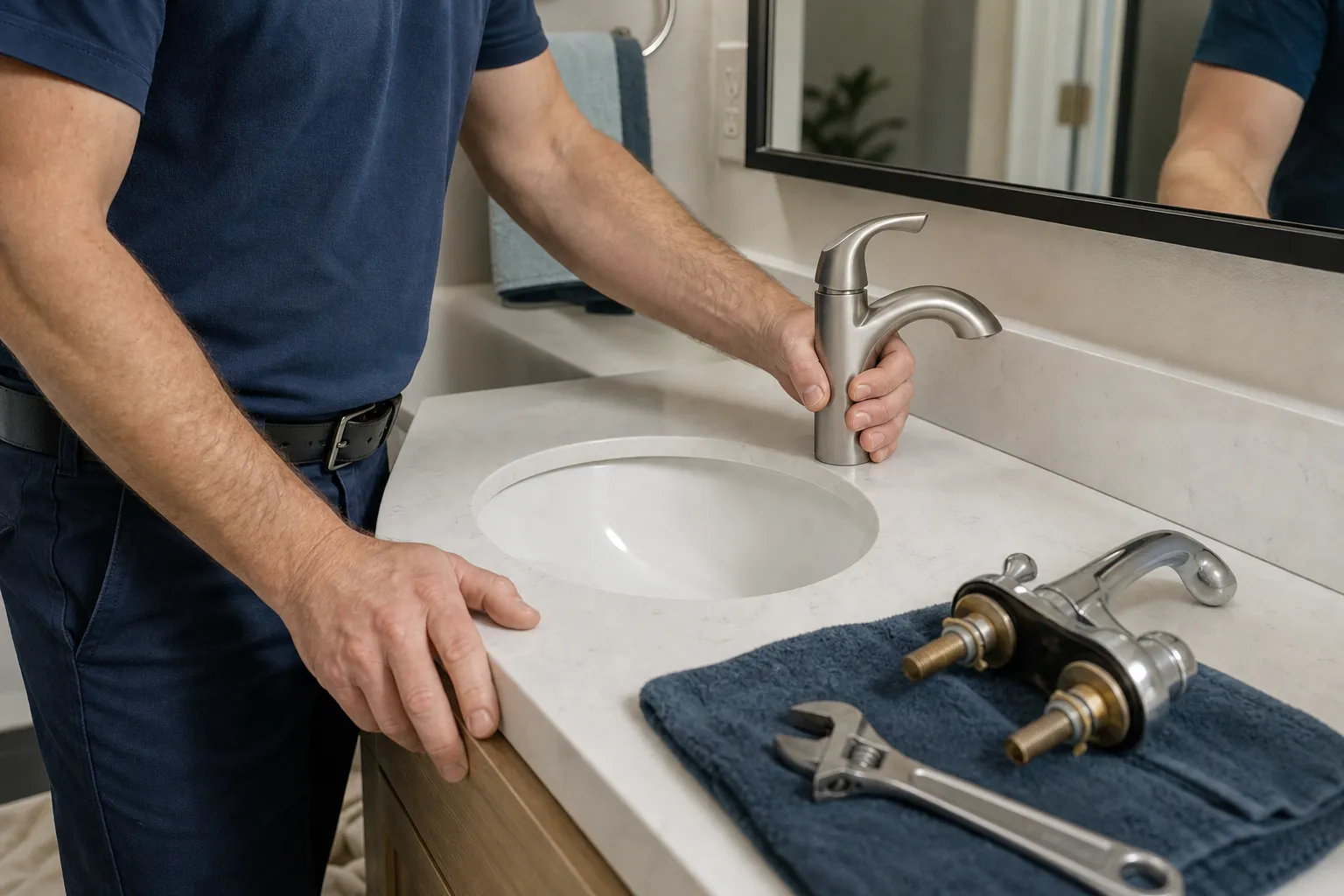
Swapping out a bathroom faucet is one of the highest-impact upgrades you can do in an afternoon - a fresh faucet instantly modernizes a vanity, and it's a genuinely approachable DIY job. The work itself is simple: shut off the water, disconnect the old faucet, set the new one, and hook the supply lines back up. What trips people up is rarely the new faucet - it's the twenty-year-old corroded nuts wedged in the cramped space under the sink.
The good news: if your shutoff valves work and the mounting nuts come loose, most people can do this start to finish in under an hour. When to call a pro: if the angle-stop shutoffs are frozen or leak when you turn them, the mounting nuts are rusted solid, or you find corroded supply lines you're not comfortable replacing, it's worth a professional visit - a stuck shutoff especially can turn a simple swap into a flood. Here's the full process.
Before You Start: Check the Fit and the Shutoffs
Two quick checks save headaches. First, confirm your new faucet matches the number of holes in your sink or countertop - bathroom sinks come in single-hole, 4-inch centerset, and 8-inch widespread configurations. Second, look under the sink for the two small oval or football-shaped angle stops (shutoff valves) on the hot and cold supply lines. You'll be closing these first; if they look heavily corroded, be ready for the possibility they won't fully seal.
Tools & Materials You'll Need
- Your new faucet (with its gasket, mounting hardware, and any included supply lines)
- A basin wrench - the one tool that actually reaches the mounting nuts up behind the sink
- Adjustable pliers or a wrench
- New flexible braided supply lines (replace the old ones while you're in there)
- Plumber's putty or silicone (only if your faucet's gasket calls for it)
- A bucket, a towel, and a flashlight
- Penetrating oil for stubborn corroded nuts
How to Replace a Bathroom Faucet, Step by Step
Shut off the water at the angle stops
Turn both shutoff valves clockwise until they stop. Then open the old faucet to release pressure and confirm the water is truly off - a dribble that won't quit means a shutoff isn't sealing, and you'll need to close the main before going further.
Disconnect the supply lines
Put a bucket and towel underneath. Unthread the supply lines from the bottom of the faucet tailpieces (and from the shutoffs if you're replacing the lines). A little water will spill from the lines - that's normal.
Remove the old faucet's mounting nuts
This is the hard part. Reach up behind the basin with a basin wrench and loosen the mounting nuts holding the faucet down. If they're corroded solid, hit them with penetrating oil, give it 10–15 minutes, and try again. Don't force a rounded-off nut - patience beats a stripped fitting.
Lift out the old faucet and clean the surface
With the nuts off, lift the old faucet free from the top. Scrape away the old putty, gasket residue, and any grime or mineral crust from the sink deck so the new faucet seats on a clean, flat surface.
Set the new faucet with its gasket
Most modern faucets come with a rubber or foam base gasket - press it onto the faucet's underside (or use a bead of plumber's putty if the instructions call for it instead). Feed the faucet and its tailpieces down through the sink holes and center it.
Tighten the new mounting nuts
From underneath, thread on the new mounting nuts and snug them with the basin wrench while holding the faucet straight and centered on top. Firm and even - not gorilla-tight, which can crack the fixture or the sink.
Reconnect the supply lines
Connect the hot and cold supply lines to the correct tailpieces and back to the shutoffs. Hand-tighten, then add about a quarter turn with pliers - no more. Braided lines seal with a rubber washer, so overtightening only damages it.
Turn the water on and check for leaks
Slowly open both shutoffs. With the faucet still off, watch every connection for drips. Then run the faucet hot and cold, and check underneath again - including where the drain and supplies meet. A connection that weeps just needs a slight extra snug.
Common Mistakes to Avoid
- Forcing a corroded mounting nut. Rounding it off makes the job far harder. Penetrating oil and a few minutes of patience almost always win.
- Reusing old supply lines. They're a few dollars new. Old braided or hard lines are exactly the parts that fail and leak later - swap them while you're already under there.
- Overtightening everything. Fixtures crack and rubber washers deform under too much force. Snug plus a small turn is the rule for supply connections.
- Skipping the gasket or putty. Set a faucet dry on the deck and water will seep under its base and pool on the vanity.
- Not testing before you call it done. Run both temperatures and check every joint. A slow drip you miss now becomes a warped cabinet floor later.
When to Call a Handyman
If the shutoff valves are frozen, leaking, or won't hold, the mounting nuts are rusted beyond freeing, or you open things up and find corroded lines or a cracked sink deck, it's time to call in help before a small job becomes a wet one. Our faucet replacement service in Santa Clarita handles the whole swap - including replacing tired angle stops and supply lines - so it's done right and leak-free in a single visit.
Estimated time: 45–60 minutes for a straightforward swap; add time if corroded nuts or a stuck shutoff put up a fight.