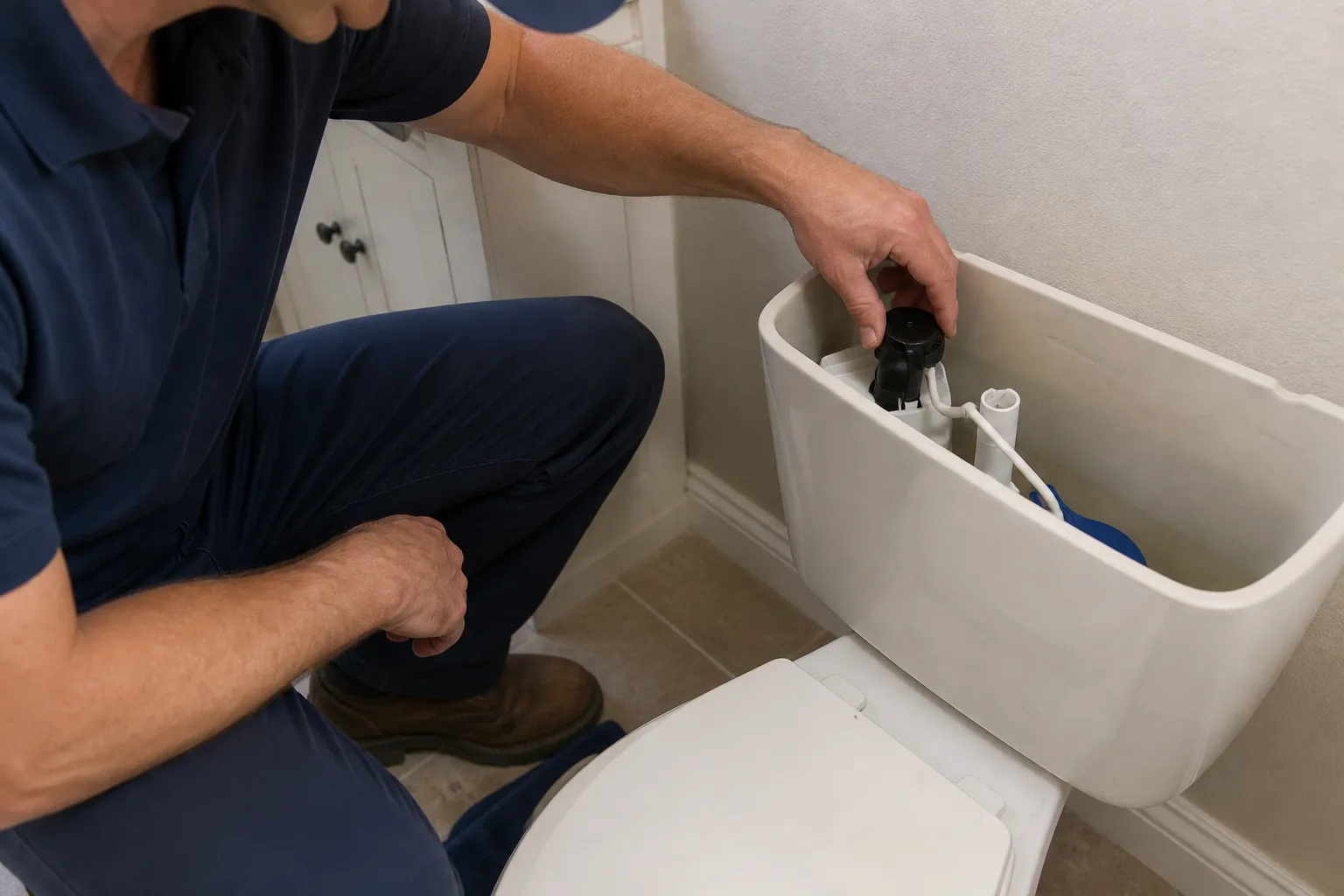
That faint, endless hiss from the bathroom - or a toilet that randomly "refills" itself every few minutes when nobody's touched it - is one of the most common and most wasteful problems in a home. A running toilet can quietly send hundreds of gallons a day down the drain, and you're paying for every one of them. The upside: nine times out of ten it's one of two cheap parts inside the tank, and both are easy to diagnose and replace yourself.
The good news: almost every running toilet comes down to a worn flapper or a tired fill valve, and a replacement part costs a few dollars at any hardware store. When to call a pro: if the tank is cracked, water is pooling on the floor around the base, or you've swapped both parts and it still runs, the problem is beyond the usual tank parts and worth a professional look. Here's how to find the real cause in about two minutes.
How a Toilet Tank Works (the 20-Second Version)
Everything you need to fix is inside the tank. When you flush, the flapper - a rubber seal at the bottom - lifts and lets the tank water rush into the bowl. As the tank empties, the float drops, which opens the fill valve to refill the tank. When the water rises back to the set level, the float shuts the fill valve off. A toilet "keeps running" when one of those three things fails: the flapper doesn't seal, the float is set too high (water spills into the overflow tube), or the fill valve won't shut off.
Diagnose It First: Flapper vs. Fill Valve vs. Float
Take the tank lid off, set it somewhere safe, and watch. This quick triage tells you which part to fix:
- Do the dye test for a bad flapper. Put a few drops of food coloring (or a dye tablet) in the tank and don't flush for 15–20 minutes. If color seeps into the bowl, the flapper is leaking and letting tank water escape - the number-one cause.
- Check the water level for a float problem. Look at the tall overflow tube in the center. If water is trickling into that tube, the water level is set too high and is spilling over - the float needs lowering.
- Listen for a fill valve that won't stop. If the fill valve keeps hissing and running even when the water is at the right level and the flapper seals, the valve itself is worn and needs replacing.
Tools & Materials You'll Need
- Food coloring or a toilet dye tablet (for the test)
- A replacement flapper that matches your toilet - take the old one to the store to match it
- A universal fill valve (only if the valve is the culprit)
- Adjustable pliers or a small wrench
- An old towel and a small sponge or cup to bail the tank
Fixing the Most Common Cause: The Flapper
Shut off the water and empty the tank
Turn the supply valve on the wall behind the toilet clockwise to close it. Flush to drain the tank, then sponge out the last bit of water.
Unhook and inspect the old flapper
Unclip it from the two pegs at the base of the overflow tube and unhook the chain from the flush lever. A flapper that's warped, stiff, slimy, or has a curled edge won't seal - that's your leak.
Fit the new flapper and set the chain
Clip the matching replacement onto the same pegs and reconnect the chain to the lever. Leave just a little slack - about a half-inch. Too tight and the flapper won't seal; too loose and it won't lift fully.
Turn the water back on and test
Open the supply valve, let the tank fill, and repeat the dye test. No color bleeding into the bowl and no more hiss means the fix held.
Adjusting the Float
If water is spilling into the overflow tube, the level is too high. On a modern column-style fill valve, pinch the clip on the side and slide the float cup down an inch, then flush and check. On an older ball-and-arm float, turn the adjustment screw on top of the valve (or gently bend the metal arm down). You want the water to stop about an inch below the top of the overflow tube.
Replacing the Whole Fill Valve
If the flapper is good and the level is right but the valve still won't stop running, swap the valve. With the water off and tank empty, disconnect the supply line underneath, unthread the locknut holding the valve to the tank, and lift the old valve out. Drop in the new one, set its height to match your tank, tighten the locknut by hand plus a light turn, reconnect the supply line, and turn the water back on. Most universal valves take about 15 minutes.
Common Mistakes to Avoid
- Guessing instead of doing the dye test. It takes 15 minutes and tells you for certain whether the flapper is the problem before you buy anything.
- Buying a flapper that doesn't match. Flappers vary by size and style. Bring the old one to the store rather than eyeballing it.
- Setting the chain too tight. A short chain holds the flapper slightly open - the exact leak you're trying to fix.
- Over-tightening plastic nuts. The locknut and supply connections are plastic; hand-tight plus a small turn is plenty. Cranking them cracks the fitting.
- Ignoring the water on the floor. A running tank is one thing; water at the base means a failed seal or a cracked tank - stop and get it looked at.
When to Call a Handyman
If you've replaced the flapper and the fill valve, checked the float, and the toilet still runs - or if you find a cracked tank, a leak at the base, or corroded shutoff valves that won't turn - it's time for a pro. While we're there, it's a good moment to knock out any other small plumbing fixes on your list. Our faucet and fixture replacement service in Santa Clarita covers running toilets, dripping faucets, and worn shutoff valves, often bundled into one same-visit repair.
Estimated time: 10–15 minutes for a flapper swap; about 15–20 minutes to replace a fill valve.