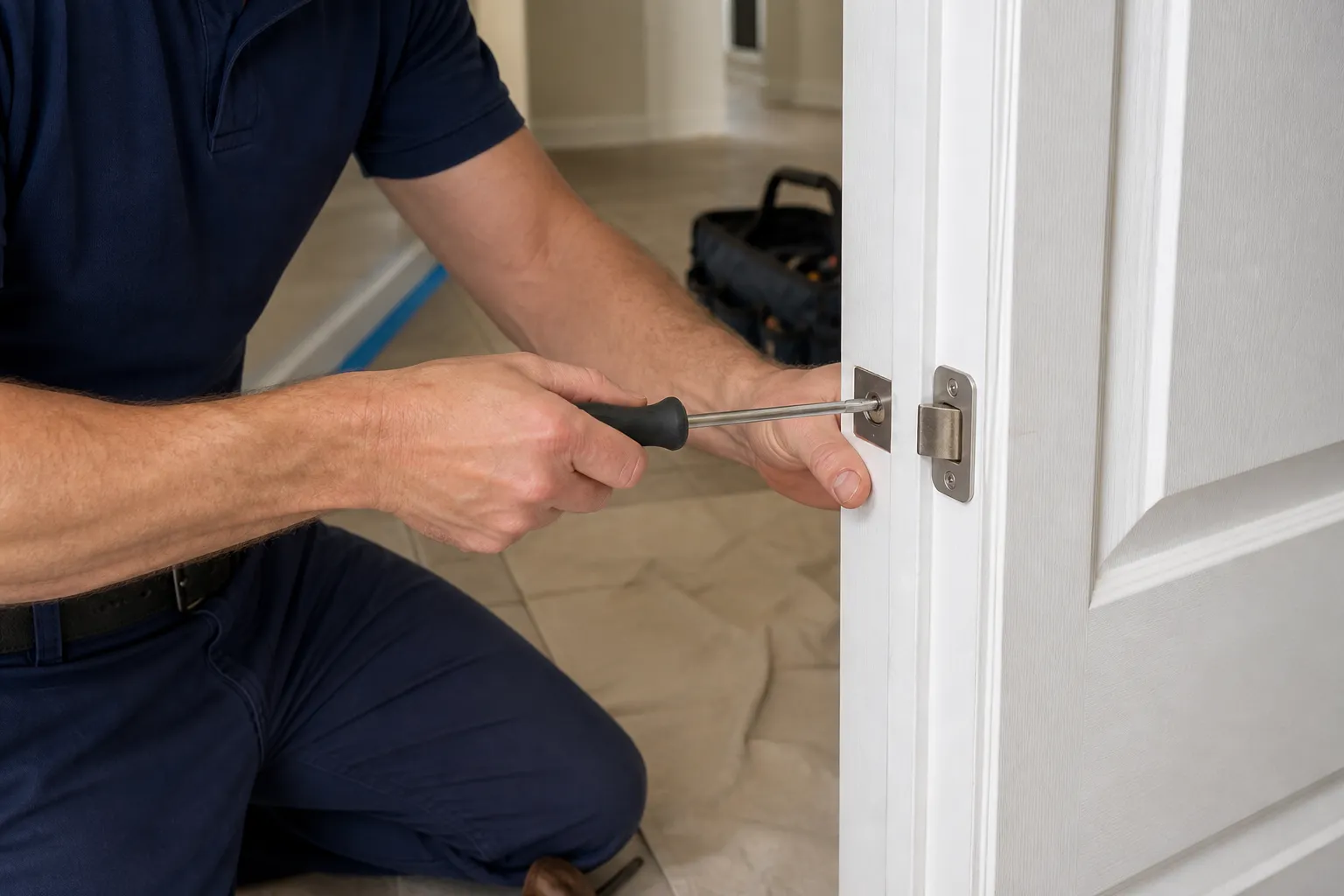
A door that swings shut but won't stay shut - it drifts back open, or you have to lift the handle and lean on it to catch - is one of the most common and most fixable problems in a house. In almost every case the door and the latch are fine. The strike plate, the metal plate on the frame that the latch bolt drops into, is a hair out of line with where the latch now lands.
The good news: nine times out of ten this is a 15-minute fix with a screwdriver and a file, and you rarely need to buy anything. When it's better to call a pro: if the door has also started sticking, the gaps around it look uneven, or several doors in the house drifted out of latch around the same time, the frame itself has likely shifted - and moving the strike plate only chases the symptom. We'll cover both.
First, Find Out Why It Won't Latch
The latch bolt has to line up with the hole in the strike plate in two directions: up-and-down, and in-and-out. Close the door slowly and watch what happens:
- The latch hits the plate above or below the hole: the door has dropped (usually loose hinges) or the plate is set too high or low. This is a vertical alignment problem.
- The latch reaches the hole but won't go deep enough to grab: the door isn't closing far enough into the frame - the plate needs to move toward the stop, or the door needs to sit tighter.
- The door bounces back before the latch touches anything: the door isn't seating in the frame at all - often a swollen door, a bad weatherstrip, or a warped slab.
The Lipstick (or Marker) Trick
To see exactly where the latch is landing, rub a little lipstick, a dab of marker, or a smear of chalk on the tip of the extended latch bolt. Pull the door almost closed so the latch just kisses the strike plate, then open it back up. The mark it leaves on the plate - or on the frame beside the plate - tells you precisely which way to move things. High, low, or short: the smudge doesn't lie, and it beats guessing.
Tools & Materials You'll Need
- Phillips screwdriver
- Lipstick, a marker, or chalk (to mark the latch)
- A metal file - a round or half-round "rat-tail" file works best for enlarging the plate hole
- A sharp chisel and utility knife (only if you have to move the plate)
- A few thin cardboard or hinge shims (business cards work in a pinch)
- Longer 3-inch screws, in case a hinge screw has stripped out
How to Fix a Door That Won't Latch, Step by Step
Mark the latch and read the smudge
Use the lipstick trick above to find exactly where the latch is contacting. A mark high on the plate means the latch is riding low; a mark low means it's riding high; a mark on the strike plate face (not in the hole) means the door isn't closing far enough.
File the strike plate hole for small misalignments
If the latch is off by less than about an eighth of an inch, don't move anything - just enlarge the hole. Unscrew the strike plate, clamp it or hold it firmly, and file the edge in the direction the latch needs to travel. Re-mount it and test. This is the cleanest fix and leaves no patching behind.
Move the strike plate for larger gaps
If the latch misses by more than a file's worth, reposition the plate. Unscrew it, then deepen or extend the mortise (the recess it sits in) with a sharp chisel so the plate sits flat in its new spot. Drill fresh pilot holes and re-screw. You may need to fill the old screw holes with a bit of wood filler or a glued toothpick so the new screws bite.
Shim the hinges to shift the whole door
Sometimes the plate is fine and the door has simply dropped or drifted. You can move the door itself by shimming a hinge. Loosen one hinge leaf on the frame, slip a thin cardboard shim behind it, and re-tighten - this nudges the door toward the latch side. Shimming the top hinge raises the latch edge; shimming the bottom hinge lowers it. Make small changes and re-test after each.
Tighten loose hinge screws
Before you shim anything, snug up every hinge screw. A sagging door is very often just loose hinges. If a screw spins without biting, swap it for a 3-inch screw that reaches past the frame into the stud - this alone re-seats a lot of doors and brings the latch back in line.
Check the latch mechanism itself
If the door lines up perfectly and still won't catch, the latch may be worn or sticky. Work the handle with the door open: the bolt should spring out fully and snap back crisply. A bolt that's sluggish, barely extends, or doesn't return is a worn latch - a few dollars and a couple of screws to replace, and often the real culprit on an old handset.
Common Mistakes to Avoid
- Moving the strike plate before checking the hinges. If the door is sagging, re-cutting the mortise just locks in the sag. Tighten hinges first.
- Filing the plate in the wrong direction. Always mark the latch first - a smudge takes ten seconds and saves you from filing the hole the wrong way.
- Over-filing. Take off a little, test, repeat. Enlarge the hole too far and the latch rattles loose instead of holding.
- Ignoring a worn latch. If the bolt itself is sluggish, no amount of plate adjustment will make it grab.
When to Call a Handyman
Call a pro if several doors fell out of latch at once, the door also sticks or scrapes, the frame corners show diagonal cracks, or the mortise work looks like more than you want to chisel. Those point to a frame that has moved, and the lasting fix is re-shimming or re-hanging the door rather than chasing the strike plate. Our door repair service in Santa Clarita realigns strike plates, re-mortises frames, and swaps worn latches in a single visit.
Estimated time: 10–20 minutes to file a strike plate; 30–45 minutes if you have to move the plate or shim a hinge; a professional frame realignment is typically a 1–2 hour visit.