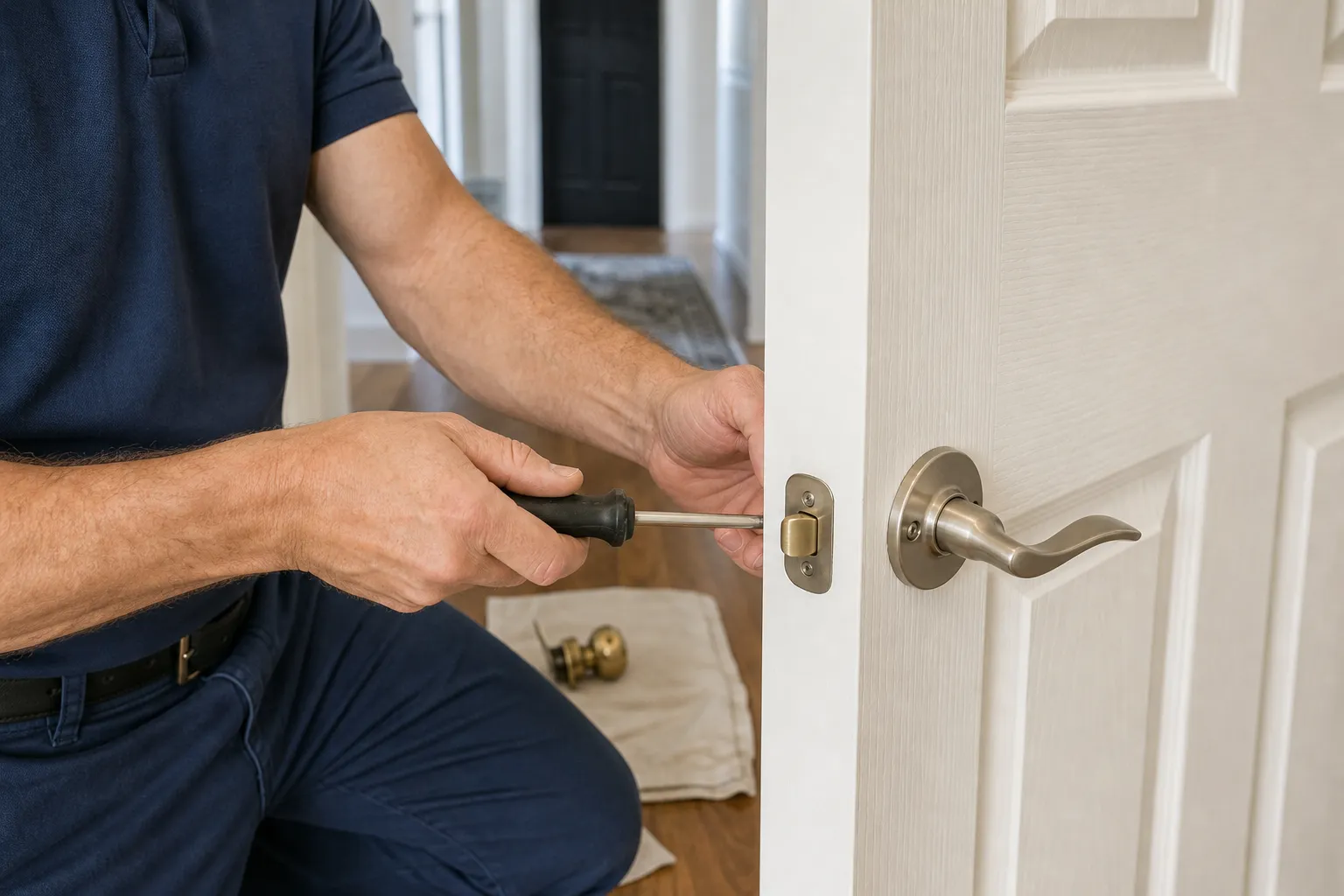
Swapping out an interior door handle - a worn bedroom knob, a lever that won't spring back, or a builder-grade set you just don't like - is one of the friendliest jobs in the house. Most interior handles come off with two visible screws, and the new one goes on the same way. From start to finish it's usually about 15 minutes per door.
The good news: if you buy the right size, this is a screwdriver-only job with no drilling and no patching. The one thing that trips people up: handles come in different sizes, and a set that doesn't match your door's existing holes won't install. So before you touch the old handle, measure - we'll show you exactly what to check so your new set drops right in.
Measure Before You Buy
Two measurements decide whether a new handle fits. Get these right and the rest is easy.
Backset - the 2-3/8" vs 2-3/4" question
The backset is the distance from the edge of the door to the center of the bore hole (the big round hole the handle sits in). There are only two standard interior backsets: 2-3/8 inches (common on interior doors) and 2-3/4 inches (common on exterior and some larger interior doors). Measure from the door edge to the center of the knob. Most replacement sets include an adjustable latch that covers both, but confirm before you buy - a mismatched backset means the handle spindle won't line up with the latch.
Bore size
The bore is the diameter of the face hole. The near-universal standard is 2-1/8 inches, and the latch edge hole is 1 inch. Virtually every off-the-shelf residential handle is built for these, so unless your door is unusual, a standard set will fit. Measure anyway if the door is old or custom.
Passage, Privacy, or Dummy - Pick the Right Type
Interior handles come in three functions, and they are not interchangeable:
- Passage set: turns from both sides, no lock. Use for closets, hallways, and rooms that don't need privacy.
- Privacy set: locks from the inside with a push-button or turn, with a small emergency-release hole on the outside. Use for bedrooms and bathrooms.
- Dummy set: a fixed handle that doesn't turn and has no latch - just a pull. Use on one leaf of a double closet door or a pantry that catches with a ball-catch or roller.
Buy the function that matches the room. A privacy set on a closet is wasted money; a passage set on a bathroom leaves you with no lock.
Tools & Materials You'll Need
- Phillips screwdriver (occasionally a flat-head)
- Tape measure (for backset and bore)
- The new handle set - matched for backset and function
- A small flat tool or paperclip (for hidden-screw knob designs)
- A pencil, in case you need to mark the latch orientation
How to Replace an Interior Door Handle, Step by Step
Remove the old handle
Open the door and find the two screws on the interior rose (the plate behind the handle). Back them out and the two halves pull apart from each side. If you see no screws, the set has a hidden clip - look for a small slot on the neck of the knob, press it with a paperclip or flat tool, and the handle slides off to reveal the mounting plate underneath.
Take out the old latch
On the edge of the door, remove the two screws holding the latch faceplate. Slide the latch bolt straight out of its hole. Note which way the curved (beveled) side of the bolt faces - it should face the direction the door closes.
Set the backset and install the new latch
If your new latch is adjustable, set it to your measured backset (2-3/8" or 2-3/4"). Slide it into the edge hole with the beveled side facing the door stop, then screw the faceplate down. The bolt should sit flush and spring freely.
Fit the two handle halves
Push the exterior half's spindle and posts through the latch and the bore hole. On a privacy set, make sure the locking side faces the room you want to secure. Line up the interior half so its screw posts meet the exterior half through the openings in the latch.
Screw it together and test
Drive the two mounting screws evenly - snug both a few turns each rather than fully tightening one first, so the handle seats square. Then test: the handle should turn smoothly, the bolt should retract fully, and a privacy button should lock and release. Close the door and confirm it latches; if it catches on the strike plate, that's a separate alignment tweak.
Common Mistakes to Avoid
- Buying before measuring the backset. A 2-3/8" set on a 2-3/4" door won't reach the latch. Measure first, every time.
- Installing the latch bolt backward. The beveled side must face the way the door closes, or the door won't push shut.
- Grabbing the wrong function. A passage set has no lock - don't put one on a bathroom. A dummy set doesn't latch at all.
- Over-tightening one screw first. Snug both mounting screws gradually so the handle doesn't bind or sit crooked.
When to Call a Handyman
Call a pro if the new handle won't line up because the bore or backset doesn't match a standard set, if the door needs the holes re-drilled or bored fresh, or if the latch won't catch even with a new handle (a strike-plate or frame issue). Our door repair service in Santa Clarita handles handle swaps, fresh boring for non-standard doors, and strike-plate alignment in one visit - and can knock out every door in the house in an afternoon.
Estimated time: about 15 minutes per door once you have the right set; add a few minutes to measure the first one.