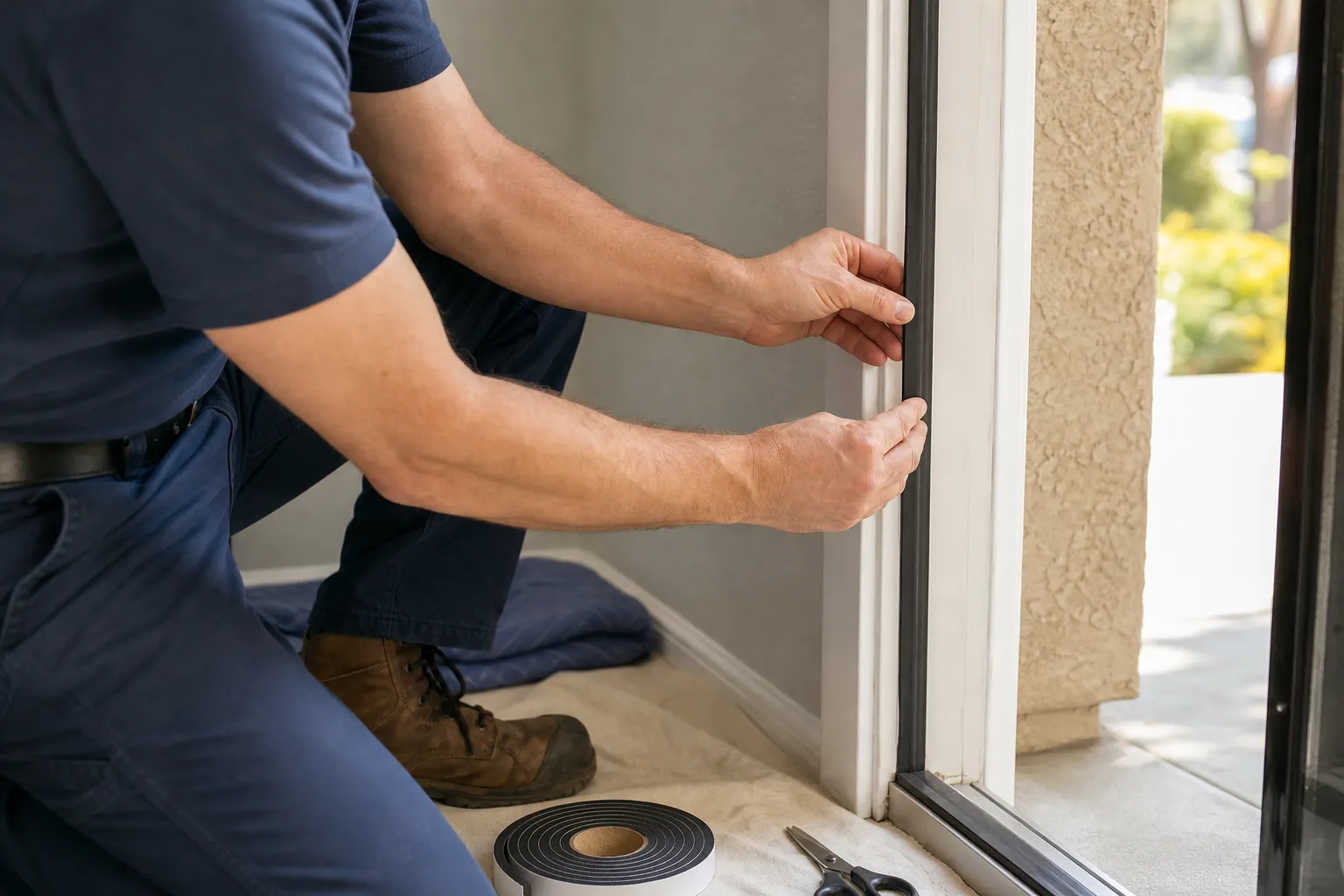
If you can feel a draft at your front door, see daylight under it, or watch dust drift in along the threshold, your weatherstripping has given out - and replacing it is one of the highest-payback afternoons you can spend on a house. Fresh weatherstripping seals out heat, dust, and noise, and it takes a noticeable bite out of a summer cooling bill. Best of all, it's a genuine DIY job that needs a tape measure, a pair of scissors, and about an hour.
The good news: most exterior doors take standard, off-the-shelf weatherstripping that installs with peel-and-stick backing or a few screws. When it's better to call a pro: if the door itself is warped, the gaps are wildly uneven, or the door still won't seal after you've stripped it, the door or frame is out of square and needs adjusting first - sealing a crooked door just wastes stripping. We'll cover how to tell the difference below.
Find the Drafts First
Before you buy anything, figure out exactly where the air is getting in - it's rarely the whole perimeter. On a breezy day, or with a helper running a hair dryer or fan outside, do this:
- The daylight test: stand inside with the lights off in daytime and look around the closed door. Anywhere you see light, air is moving.
- The paper test: close the door on a sheet of paper and pull. If it slides out with no drag, that spot isn't sealing.
- The hand test: run a damp hand slowly along the seams on a windy day - moving air feels cold even in summer.
Mark the leaky spots with tape. Most doors leak at the bottom (the sweep) and along one side (the strike jamb), and knowing that saves you money on materials.
Know the Types (and Where Each One Goes)
There isn't one "weatherstripping" - there are a few, each suited to a different part of the door:
- Adhesive foam tape: the cheapest and easiest. It compresses against the door when it shuts, so it's ideal for the top and side jambs where the door presses flat. Peel-and-stick; no tools. It wears faster than the others, so think of it as the quick win.
- V-strip (tension seal): a folded strip of vinyl or metal that springs against the door edge. It's more durable than foam and hides in the gap, making it the best choice for the sides of a door that closes with a small, even gap.
- Door sweep: mounts along the bottom edge of the door and seals the gap to the threshold. This is the big one for dust and drafts - most of what blows in comes under the door. Sweeps screw or stick on and are trimmed to width.
- Threshold seal: the rubber or vinyl insert that sits in the threshold itself. If yours is flattened, cracked, or missing, replacing the insert restores the bottom seal without touching the door.
Tools & Materials You'll Need
- Tape measure
- Scissors or a utility knife (and a hacksaw or tin snips if your sweep has a metal channel)
- Screwdriver or a drill for screw-on sweeps
- A rag and rubbing alcohol to clean the surfaces
- Your chosen weatherstripping - measured to the door
Measure and Install, Step by Step
Measure the door, not the box
Measure the two sides and the top of the door where the stripping will sit, and measure the bottom width for the sweep. Buy a little extra - it's cheaper than a second trip. Standard exterior doors are close to 36 inches wide and 80 inches tall, but measure yours.
Clean and dry the surfaces
Peel off the old stripping, scrape any leftover adhesive, and wipe the jambs and door edge with rubbing alcohol. Adhesive foam and V-strip only bond to a clean, dry, dust-free surface - and Santa Clarita doors collect a lot of fine dust.
Apply the side and top seals
Cut foam or V-strip to length and press it into place with the door closed against it, so it seats where the door actually contacts the frame. Work in one continuous piece per side to avoid gaps at the joints.
Fit the door sweep
Hold the sweep against the bottom of the closed door so it just brushes the threshold - tight enough to seal, loose enough to swing freely. Mark, trim to width, then screw or stick it on. Open and close a few times to confirm it drags the floor without binding.
Test your work
Repeat the daylight and paper tests. No light, and the paper now drags at every edge? You've sealed it. If one spot still leaks, that's usually a sign the door sits unevenly in the frame.
Common Mistakes to Avoid
- Sticking foam to a dusty jamb. It'll peel off within weeks. Clean and dry first, every time.
- Setting the sweep too tight. A sweep that jams the floor drags on the carpet and tears itself up. It should kiss the threshold, not plow it.
- Sealing a door that doesn't sit square. If gaps are wildly uneven, fix the door's fit first - weatherstripping can't bridge a quarter-inch gap on one corner.
- Buying one type for the whole door. Foam on the sides, a sweep on the bottom - match the product to the location.
When to Call a Handyman
Call a pro if the door is warped, the gaps around it are badly uneven, the threshold itself is damaged, or the door still won't seal after new stripping - all signs the door or frame is out of square. Our door repair service in Santa Clarita re-aligns sagging doors, adjusts strike plates and thresholds, and fits weatherstripping so the door seals evenly all the way around, not just where it happens to touch.
Estimated time: about 1 hour per door for a full re-strip; 15–20 minutes to swap just a worn door sweep.