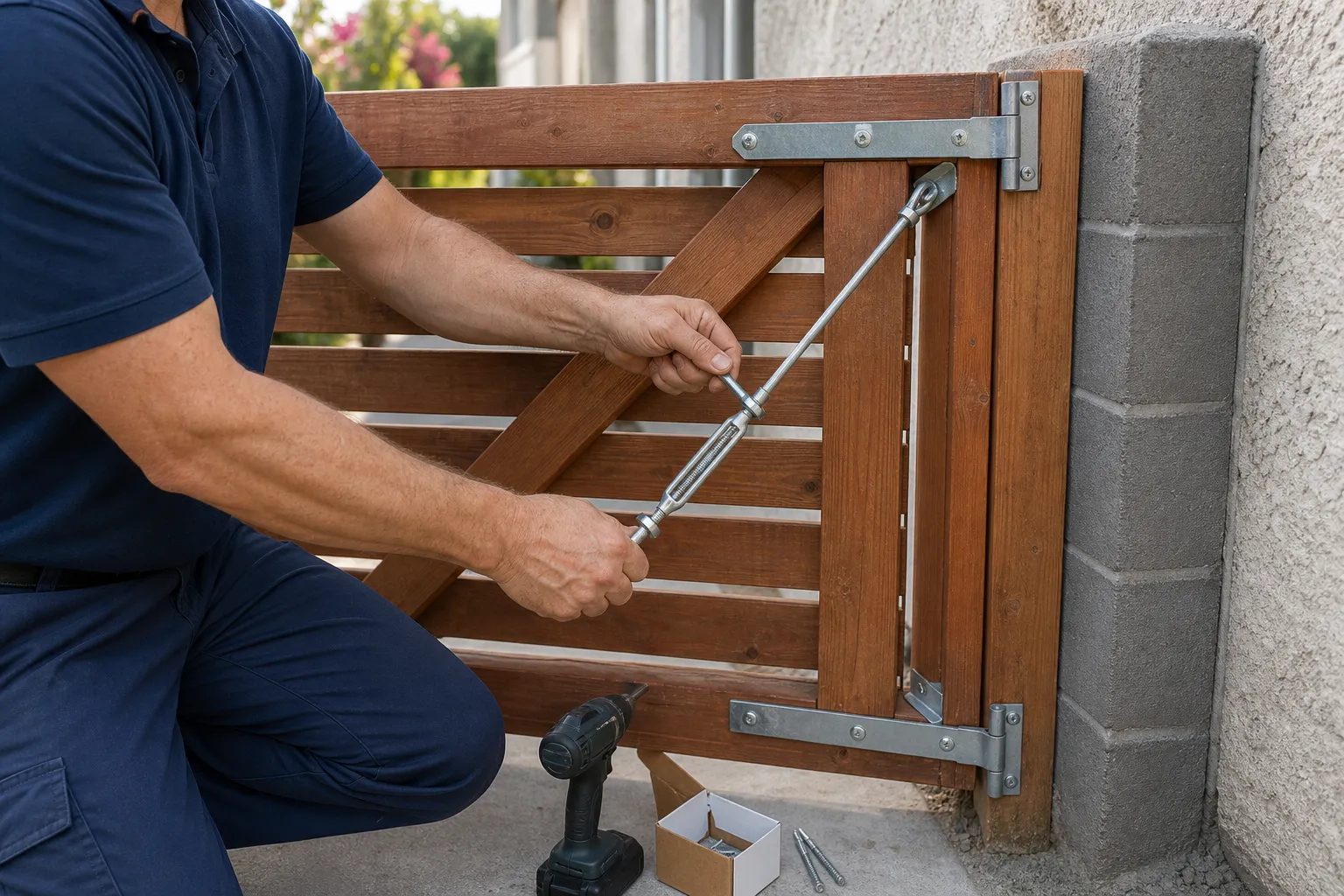
A gate that won't close is annoying every single time you use it - you lift it, shove it, and wrestle the latch until it finally catches. But the fix is usually straightforward once you figure out why it's binding. Almost every stubborn gate comes down to one of three things: the gate itself has sagged out of square, the post it hangs on has leaned, or the hinges and latch have simply worked loose.
The good news: if the post is still solid and the gate just droops on the latch side, you can often pull it back into line in under an hour with a turnbuckle kit and a screwdriver. When it's better to call a pro: if the post itself is leaning, rotten at the base, or loose in the ground, no amount of hinge tightening will hold - the post has to be reset, and that's the real repair. Here's how to tell which one you're dealing with.
Diagnose It First: Sag vs Post Lean vs Hardware
Stand back and watch the gate as you swing it. The clue is which corner drops and whether the post moves with it.
- Sagging gate: the latch-side bottom corner drags or drops, and the gap along the top opens up into a wedge. The post is fine; the gate frame has racked out of square. This is the most common case.
- Leaning post: grab the hinge post and push - if it rocks in the ground or tilts toward the gate, the post is the problem. A leaning post drags the whole gate down with it.
- Loose hinges or latch: the gate hangs square but the latch misses the catch, or a hinge visibly wiggles. This is pure hardware - the quickest fix of the three.
A quick check: hold a level against the hinge post. Plumb post plus a drooping gate means sag (fix the gate). Out-of-plumb post means lean (fix the post).
Tools & Materials You'll Need
- Drill/driver and a screwdriver
- Anti-sag gate kit (cable and turnbuckle)
- Longer 3-inch exterior screws for stripped hinge holes
- A level
- Replacement hinges rated for the gate's weight, if the old ones are undersized
- Bar clamp or a helper to hold the gate square while you work
- Gravel and fast-setting concrete, only if a post needs resetting
How to Fix It, Step by Step
Tighten the hinges before anything else
Support the gate's weight and firmly drive every hinge screw. If a screw spins without biting, it has stripped the hole - replace it with a longer 3-inch screw that reaches into solid framing. Loose hinges alone will make a square gate miss the latch, so rule this out first.
Install an anti-sag turnbuckle kit
If the gate is racked out of square, an anti-sag kit pulls it back. Run the cable diagonally from the top corner on the hinge side down to the bottom corner on the latch side. Getting the direction right matters - the cable has to lift the drooping latch corner. Hand-tighten the turnbuckle, then turn it a little at a time, checking the gap along the top as you go.
Snug the turnbuckle until the gate is square
Keep tensioning until the top gap is even and the latch corner has lifted enough to clear. Don't overdo it - cranking past square will bow the frame the other way. Stop the moment the gate swings free and the latch lines up.
Upgrade the hinges if they're outmatched
Heavy gates on small hinges will keep sagging no matter what. If the hinges are bent, undersized, or pulling out, swap them for larger ones rated for the gate's weight and screw into the framing, not just the pickets. Three hinges on a tall gate beat two every time.
Realign the latch
Once the gate hangs square, the latch may still sit a hair off. Close the gate, mark where the latch actually lands, and move the catch or strike to meet it. On most gate latches you just back out the screws, shift the catch up or down, and re-drive them.
Check the post if it still won't hold
If the gate goes out of square again within days, the hinge post is moving. Dig around the base to check for rot or a loose footing. A post that rocks needs to be reset in fresh gravel and concrete, or replaced - the fix that finally makes the gate stay closed.
Should You Add a Gate Wheel?
A spring-loaded gate wheel (caster) bolted to the bottom of the latch side carries some of the gate's weight on the ground, which takes strain off the hinges and post. It works well on wide or heavy gates that swing over a flat, hard surface like a driveway or a paver walk. It is not a fix for a gate that's already sagging - put the wheel on a racked gate and it just rolls the problem along. Square the gate first, then add the wheel to keep it that way. On grass, gravel, or a sloped path the wheel will dig in or drag, so skip it there.
How to Keep a Gate From Sagging Again
- Brace it the right way. A wood gate's diagonal brace should run from the bottom of the hinge side up to the top of the latch side, so it holds the latch corner up. A brace running the other way does almost nothing.
- Use enough hinge. Heavy-duty strap or T-hinges screwed into the gate frame and the post - and three hinges on anything over about 5 feet tall.
- Keep the gate light. Hanging planters or adding pickets to a gate built for fewer adds weight the hinges weren't sized for.
- Re-check the turnbuckle each fall. Wood shrinks over a dry Santa Clarita summer; a quarter turn before wind season keeps it square.
Common Mistakes to Avoid
- Running the anti-sag cable the wrong way. Hinge-top to latch-bottom lifts the sag; reversed, it makes the droop worse.
- Over-tightening the turnbuckle. Past square, you just rack the gate in the opposite direction.
- Moving the latch to chase a sagging gate. Fix the sag first; a relocated latch on a still-drooping gate binds again in a week.
- Ignoring a moving post. Every hardware fix in the world won't hold a gate on a post that rocks in the ground.
When to Call a Handyman
Call a pro if the hinge post is leaning, loose, or rotten at the base, if the gate frame joints have pulled apart, or if the gate is heavy and awkward to hold square while you work. Resetting a post and re-squaring a gate is a two-person job done right. Our fence and gate repair service in Santa Clarita resets posts, re-squares sagging gates, and upgrades to weather-rated hinges and latches so the gate closes on the first try - and keeps closing.
Estimated time: 30–60 minutes for a hinge-and-turnbuckle fix on a solid post; resetting a leaning post is a half-day job that includes concrete cure time.