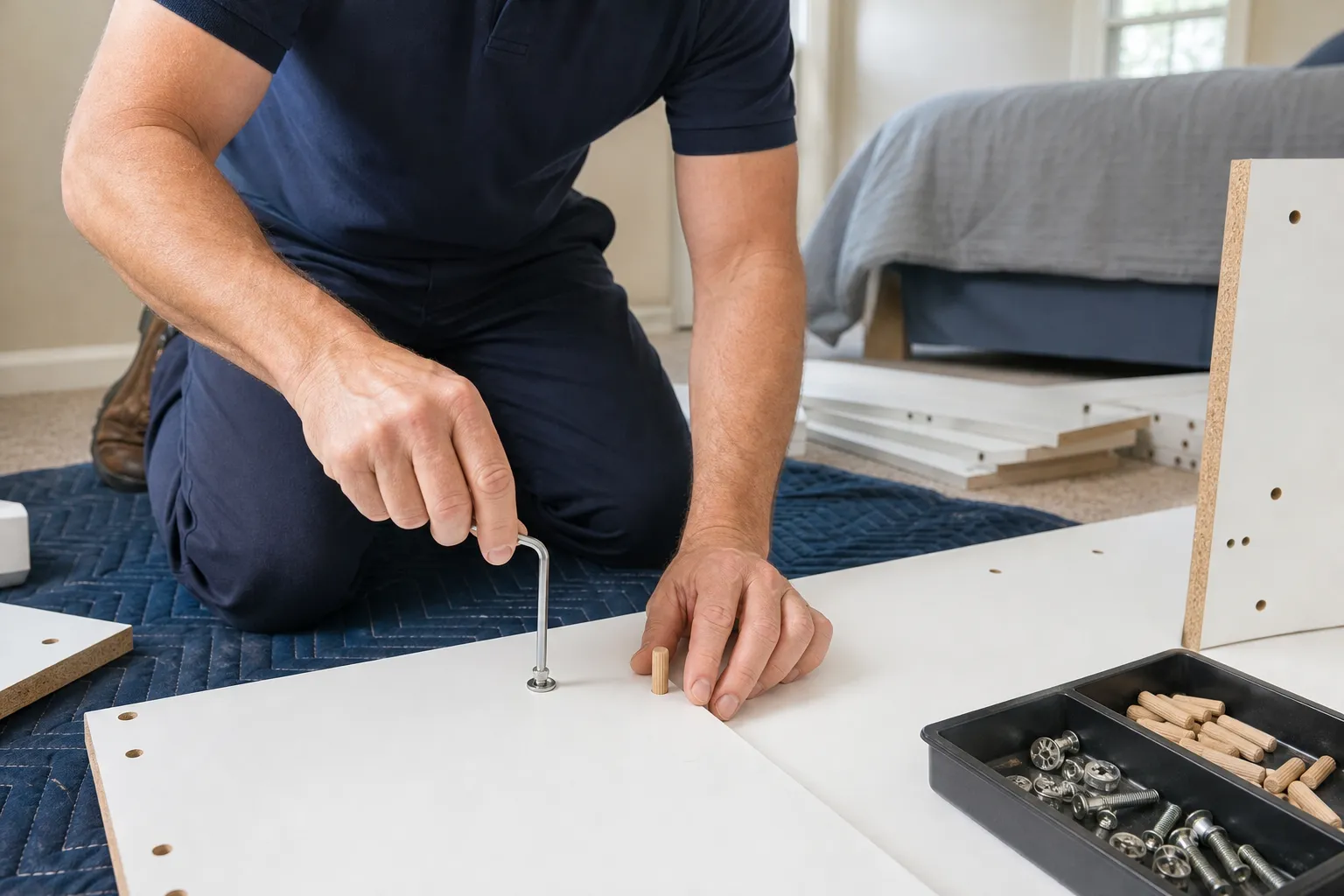
Flat-pack furniture looks simple in the box - a few boards, a bag of hardware, a little booklet of pictures. Then two hours later you've got a dresser that leans, a drawer that won't slide, and a spare cam lock you can't place. Almost every flat-pack disaster traces back to a handful of the same mistakes, and the good news is they're all avoidable if you know them going in.
When this is DIY-friendly: most nightstands, bookshelves, small desks, and single dressers are a satisfying evening project, especially with a second set of hands. When to call a pro: big wardrobes and modular closets, anything wall-mounted or tip-prone, pieces with dozens of steps, or a build where the instructions are missing, in another language, or clearly wrong. Those are the ones where a rushed hour turns into a wobbly, load-bearing problem.
Set Up Before You Build
Half of a clean assembly is the setup. Before you connect a single panel:
- A large, flat, hard surface - a hard floor or a big table, not carpet or a bed
- Space to lay every panel out and read its orientation
- A Phillips screwdriver and, if you have one, a hand screwdriver for the final turns on cam bolts
- A rubber mallet or a scrap block to tap parts together without denting them
- The full instruction booklet, read start to finish once before you begin
- The wall anchor or anti-tip strap that came in the box - set it aside, don't lose it
The Mistakes That Ruin Flat-Pack Furniture
Not sorting the hardware first
Cam locks, cam bolts, wood dowels, and three near-identical screw lengths all live in one bag, and using the wrong screw in the wrong hole is the number-one cause of a stripped or blown-out panel. Dump the bag, sort it into cups or a muffin tin, and match each pile to the parts list before step one. Five minutes here saves an hour of backtracking.
Over-tightening the cam locks
The round cam locks only need to turn until they're snug - usually about half a turn once they grab. Keep cranking and you'll strip the cam or split the particleboard from the inside, and there's no fixing a chewed-out cam hole. Snug, not gorilla-tight. The joint's strength comes from the whole panel, not from one over-torqued lock.
Putting the back panel on backwards
That thin cardboard-like back panel almost always has a finished (printed) side and a raw side. Install it raw-side-out and it shows; install it upside down and the pre-drilled nail holes won't line up. Check the finished face and the hole pattern before you tack it on - it's a pain to pry off once the little nails are in.
Skipping the anti-tip anchor
The wall strap in the bag isn't optional hardware - it's the part that keeps a dresser or bookshelf from tipping onto someone who pulls a drawer or climbs a shelf. It's the most-skipped step and the most important one, especially in a kid's room. Anchor tall pieces to a stud, every time.
Building on carpet
Carpet feels comfortable but it flexes, so a case you assemble there can rack out of square the moment you stand it on a hard floor - and suddenly the drawers bind. Screws and small parts also vanish into the pile. Build on a hard, flat surface and only move the piece to its final carpeted spot once it's done.
Ignoring left/right and panel orientation
Many side panels are mirror images with pre-drilled holes that only make sense one way. Install a side upside down or swap left for right and the shelf pins, drawer slides, or hinge holes end up on the wrong face - often several steps before you notice. Lay the panels out, match them to the diagram, and confirm orientation before driving anything.
A Few More Small Mistakes That Cost You
- Skimming the instructions. Read the whole booklet once first - the step that matters is usually the one you'd have skipped.
- Reaching for a power drill on cam bolts. A drill's torque strips soft particleboard in an instant; do the final turns by hand.
- Mixing up screw lengths. A too-long screw punches through a finished face; a too-short one won't hold. Match the length in the diagram.
- Fully tightening as you go. Leave joints slightly loose until the case is assembled and square, then snug everything down.
When to Call a Handyman
Call a pro for big wardrobes and modular closets, anything that has to be anchored or wall-mounted, multi-hour builds, or a piece where the hardware or instructions are missing or wrong. Our furniture assembly service in Santa Clarita builds it square the first time, anchors tall pieces safely to the wall, and hauls the flattened boxes away - so you skip the sore back and the leftover-part mystery.
Estimated time: 30 to 60 minutes for a nightstand or small shelf; a large wardrobe or modular unit can run two to four hours and is much easier with two people.