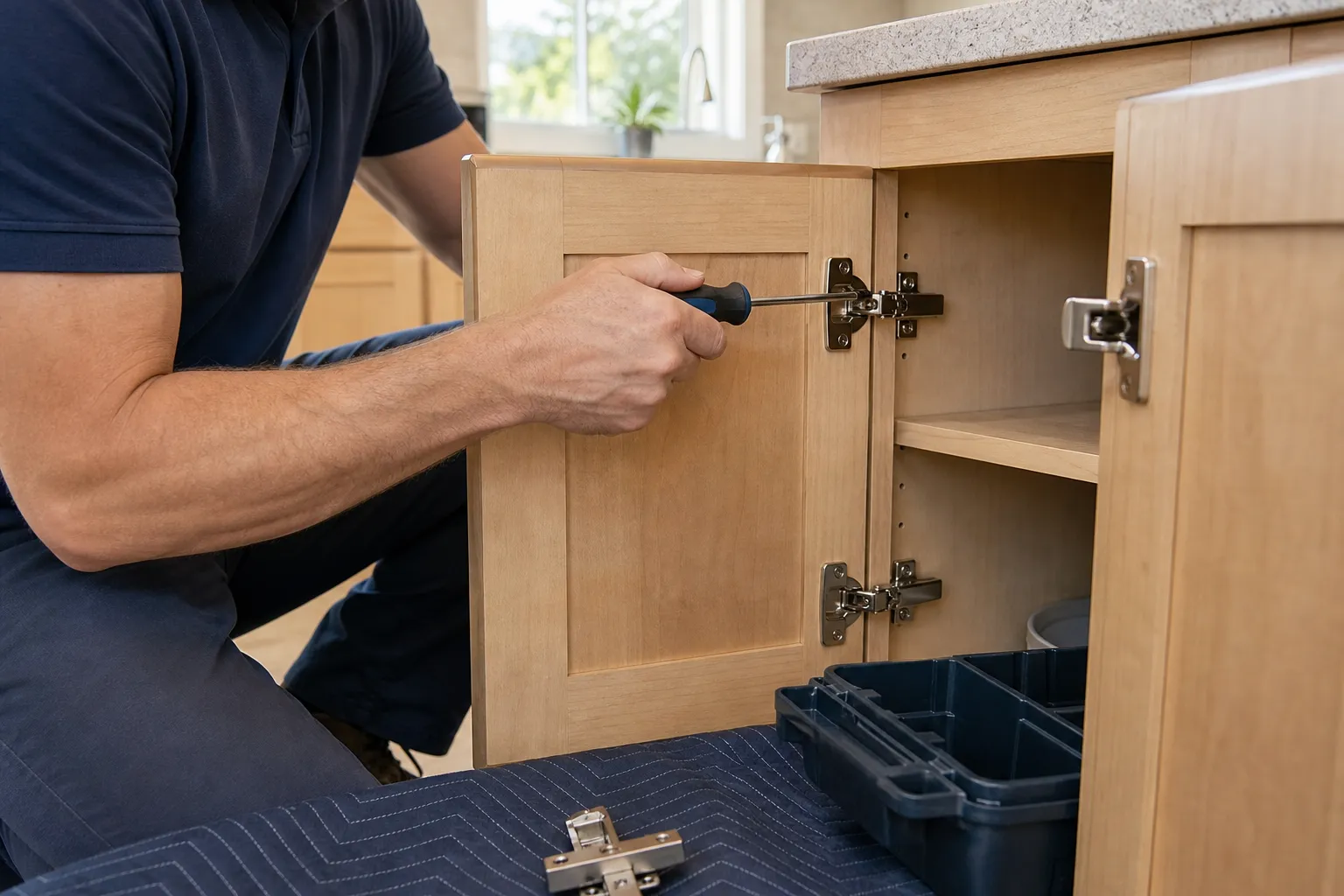
If your cabinet doors have started hanging crooked, sitting at slightly different heights, or wobbling when you tug them, the hinges have worked loose - and that's good news, because loose hinges are one of the easiest things in a kitchen to put right. Every modern concealed "European" hinge is designed to be tightened and fine-tuned with nothing more than a screwdriver, in three separate directions.
The good news: most loose-hinge fixes take a couple of minutes per door and cost nothing. When it's better to call a pro: if the screws just spin in place, the particleboard around them has crumbled, or the doors won't line up no matter how you adjust them, the cabinet itself may have shifted - and that's worth a second opinion. Here's how to work through it.
First, Figure Out What "Loose" Means
There are two different problems people call "loose hinges," and they have different fixes:
- The hinge physically wobbles or the door rattles. A mounting screw has backed out. This is a straight tighten-it-down job.
- The hinge is snug but the door hangs crooked, uneven, or with a gap. The hinge hasn't loosened - it just needs re-aligning. That's the three-way adjustment below.
Open the door and give the hinge a gentle wiggle. If it moves, tighten first. If it's solid but the door still looks off, skip to the adjustment.
Tools & Materials You'll Need
- Phillips screwdriver (a #2 fits most cabinet-hinge screws)
- Wood glue and toothpicks, wooden matchsticks, or golf tees
- A few slightly longer or thicker screws as a backup
- A flashlight and a damp rag to clean out old debris
Step 1: Tighten the Mounting Screws
A Euro hinge fastens in two places: the hinge arm screws to a mounting plate on the cabinet wall, and that plate screws into the box. Both sets can loosen from years of opening and closing.
Snug the plate screws
Find the two screws holding the mounting plate to the inside wall of the cabinet and firmly tighten them. This is where most "loose" hinges actually loosen. Don't overtighten into particleboard - stop as soon as they're snug.
Snug the hinge-arm screws
Tighten the screws where the hinge arm clips or bolts onto that plate. Test the door. If the wobble is gone and it sits straight, you're finished.
Step 2: The Three-Way Adjustment
If the hinges are tight but the door still isn't right, use the built-in adjustment screws. Each controls one direction - turn one in small quarter-turns and re-check before moving on.
Alignment (up and down)
Loosen the hinge-arm screws a quarter-turn, slide the door up or down until its top edge lines up with the doors beside it, and re-tighten. This levels a door that has sagged lower than its neighbor.
Overlay (side to side)
The front screw shifts the door left or right - how far it "overlays" the cabinet frame. Use it to center a door over its opening and to even out the vertical gap between a pair of doors.
Gap (in and out)
The rear screw moves the door closer to or farther from the frame, setting how tightly it sits when shut. Dial it so the door closes flush without the face slamming into the box.
Step 3: Fix a Stripped Screw Hole in Particleboard
This is the problem that stops most people cold: you tighten a screw and it just spins, because the particleboard around it has crumbled into powder and there's nothing left to grip. You don't need new cabinets - you need to give the screw fresh material to bite into. Two reliable tricks:
- The toothpick-and-glue fix: dab wood glue on a few toothpicks (or a golf tee for a bigger hole), pack them into the stripped hole, snap them off flush, and let the glue set. Re-drive the original screw into the new wood and it will hold like new.
- The larger-screw trick: step up to a slightly longer or thicker screw that reaches past the chewed-out zone into solid material. Keep it modest - jump too big and you'll split the panel.
Let any glue cure before you hang weight on the door, and the repair will outlast the original factory screw.
Common Mistakes to Avoid
- Overtightening into particleboard. Cranking a snug screw another half-turn is how you strip it in the first place.
- Adjusting before tightening. A loose plate makes every alignment tweak drift right back out.
- Turning two or three screws at once. You'll never know which one fixed it - or which one made it worse.
- Reusing a screw in a blown-out hole. Pack the hole first; a spinning screw only grinds the particleboard finer.
When to Call a Handyman
Call a pro if multiple screw holes have stripped, a mounting plate has torn out of the cabinet wall, the doors won't line up no matter how you adjust them, or the whole box looks racked. Those point to a cabinet that has shifted rather than a single tired hinge. Our door repair service in Santa Clarita re-anchors loose plates, repairs stripped holes, and realigns a full run of cabinet doors so they sit even - cabinet doors and passage doors alike.
Estimated time: 2–5 minutes to tighten and adjust one door; add 15–20 minutes if you need to glue and reset a stripped hole.