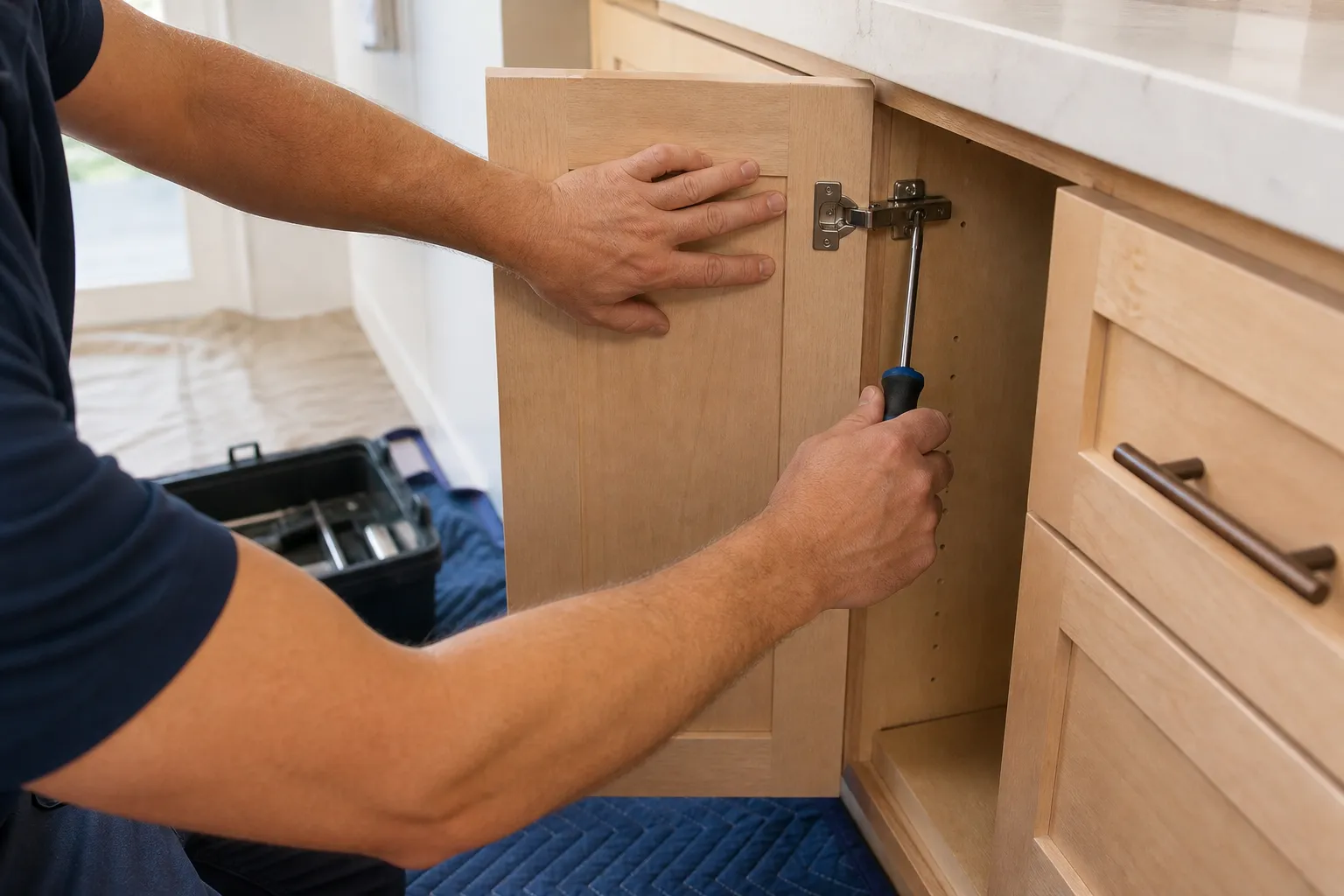
A cabinet door that drifts open on its own, sits crooked next to its neighbor, or catches the frame before it shuts is one of the most common - and most fixable - problems in a kitchen. In almost every case the door and the box are fine; it's the hinge that has drifted out of adjustment. Modern cabinets use European "cup" hinges (the concealed kind with the round barrel that sinks into the back of the door), and those hinges are built to be dialed back into position with a screwdriver.
The good news: nine times out of ten this is a five-minute fix with no new parts. When it's better to call a pro: if the door itself is visibly warped, the cabinet box is racked or pulling off the wall, or the screw holes in the particleboard have blown out so nothing bites, you're past a simple adjustment. We'll walk through the quick fixes first, then flag the cases worth handing off.
Why the Door Won't Close
Open the door and watch how it sits before you change anything. The symptom tells you which adjustment to reach for:
- Pops back open a half-inch and won't stay shut: the door isn't pulling deep enough into the frame, or the hinge's built-in spring/clip has loosened. This is the depth (in/out) screw.
- Rubs the door above or below it: the door has sagged and needs to move up or down. This is the height screw, usually on the mounting plate.
- Uneven gap down the middle of a pair of doors: the door has shifted left or right. This is the side (lateral) screw.
- Corner sticks out and the rest sits flush: often a warped door or a loose mounting plate letting the hinge float.
Tools & Materials You'll Need
- Phillips screwdriver (a #2 covers most hinge screws)
- A flashlight to see inside the cabinet box
- Replacement soft-close dampers or clip-on hinge dampers, only if yours have failed
- Wood glue and toothpicks or golf tees, only if a mounting screw has stripped
- A helper or a folded towel to hold the door steady while you adjust
The Three Adjustment Screws, One at a Time
A Euro hinge has up to three points of adjustment. Turn one screw at a time in small quarter-turns, close the door to check, then move on. Chasing all three at once is how a five-minute job becomes an afternoon.
Depth screw - stops it from popping open
The rear screw (closest to the cabinet wall, often in a slotted track) moves the door in toward the box or out away from it. If the door won't stay shut, snug it so the door pulls fully against the frame. If the door slams into the frame or the face binds, back it out slightly.
Height screw - raises or lowers the door
Loosen the two screws holding the hinge arm to the mounting plate a quarter-turn, slide the whole door up or down until it lines up with its neighbor, then re-tighten. This is the fix for a door that has sagged and started rubbing the one below it.
Side screw - closes an uneven center gap
The front screw (nearest the door) tilts the door left or right. On a pair of doors, use it to even out the gap running down the middle so the two doors sit parallel. Small turns here make a big visual difference.
Check the soft-close damper
If your doors used to ease shut and now bang, the culprit is usually a tired soft-close damper - either the little piston built into the hinge or a separate clip-on unit. Most clip-on dampers pull off and snap back on in seconds; matching hinge-integrated dampers are a cheap replacement part. A blown damper doesn't stop the door closing, but replacing it brings the quiet back.
When It's a Warped Door or a Loose Plate
Two problems won't yield to the adjustment screws. First, a warped door - common on tall pantry doors and on cabinets over a heat source - bows so one corner stands proud no matter how you dial the hinges. Adding a third hinge, or in stubborn cases replacing the door, is the real fix. Second, a loose mounting plate: if the plate that screws into the cabinet wall has worked loose, the whole hinge floats and no adjustment holds. Tighten those plate screws first; if they spin freely, the hole has stripped (see the fix below).
Common Mistakes to Avoid
- Turning all three screws at once. You lose track of what did what. One screw, one test, every time.
- Cranking a stripped screw harder. If it spins without tightening, the particleboard hole is blown - glue a toothpick or golf tee into the hole, let it set, and re-drive into fresh material.
- Blaming the door for a loose plate. Always confirm the mounting plate is tight before you touch the alignment screws.
- Buying new hinges too soon. A hinge that adjusts is a hinge that still works. New hardware only helps if the old one is actually broken or mismatched.
When to Call a Handyman
Call a pro if the door is visibly warped, the cabinet box is racked or separating from the wall, several screw holes have stripped out of the particleboard, or you have a whole kitchen of doors drifting at once (a sign the cabinets have shifted). Our door repair service in Santa Clarita handles hinge replacement, mounting-plate and stripped-hole repairs, and full cabinet-door realignment in a single visit - so the whole run lines up, not just one door.
Estimated time: 5–15 minutes to adjust a single door; 30–60 minutes for a full kitchen of doors or a stripped-hole repair.